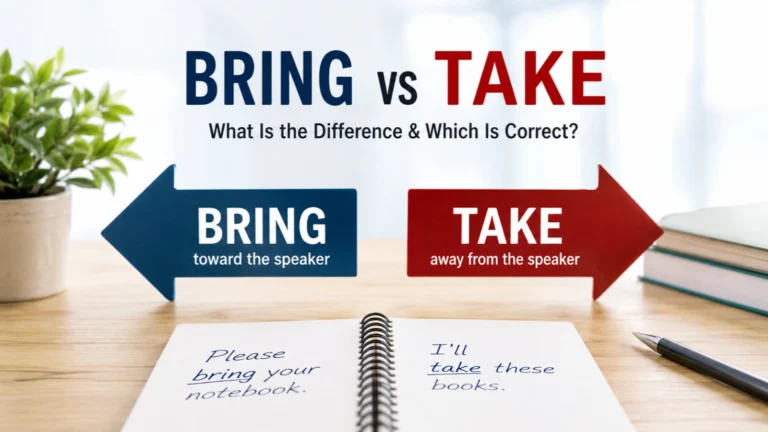
Bring vs take is one of the most common grammar questions English learners ask. At first glance, these two verbs seem almost identical because both describe moving something or someone from one place to another. However, the key difference depends on the direction of movement. Using the wrong word can make your sentence sound confusing or unnatural, even if people still understand your meaning. The good news is that the distinction is simple once you learn it. In this guide, you’ll discover the meanings of bring and take, see practical examples, avoid common mistakes, and learn easy memory tricks that will help you use these words correctly in everyday conversations and writing
Why “Bring” and “Take” Are Confusing
Many English learners confuse bring and take because both verbs describe moving something from one place to another. The difference is based on the speaker’s point of view rather than the object itself.
Here are the main reasons people mix them up:
Similar Pronunciation
Although they do not sound exactly alike, both are short, common verbs that often appear in similar situations.
Similar Spelling
The words are different in spelling, but because they are both simple four- and five-letter verbs used frequently, learners often remember them together.
Context Confusion
The biggest challenge is understanding direction.
- Bring means moving something toward the speaker or destination.
- Take means moving something away from the speaker or starting point.
Common Learner Mistakes
Many learners say:
- “I’ll bring this book to school.”
- “Can you take me your phone?”
These sentences may be incorrect depending on where the speaker is and where the object is moving.
Bring vs Take Explained Simply
Bring means moving something toward a person or place, while take means moving something away from a person or place.
One-Line Distinction
Bring = come here with it.
Take = go there with it.
Examples
Bring
- Please bring your notebook to class tomorrow.
- Can you bring me a glass of water?
Take
- I’ll take these books to the library.
- She took her umbrella to work.
Understanding Homophones in English
What Are Homophones?
Homophones are words that sound the same or nearly the same but have different meanings and spellings.
Example:
- Sea
- See
Although bring and take are not homophones, learners often confuse them because they are commonly used in similar situations.
Why Homophones Cause Confusion
When words sound alike or appear in similar contexts, learners often choose the wrong one.
Example:
- I can see the ocean.
- The sea is calm today.
Similarly, people confuse bring and take because both describe movement, even though the direction changes the correct choice.
What Does “Bring” Mean?
Definition and Core Meaning
Bring means to carry, move, or cause someone or something to come toward the speaker or another destination.
It focuses on movement to a place.
Origin and Historical Use
The word bring comes from Old English bringan, meaning “to carry” or “to convey.” It has been part of English for more than a thousand years and has always described movement toward someone or somewhere.
Modern Usage and Synonyms
Today, bring is used in everyday conversations, business English, schools, and writing.
Synonyms
- Carry
- Deliver
- Fetch
- Transport
- Present
Example Sentences
- Please bring your passport.
- Can you bring your family to the party?
- She brought flowers for her grandmother.
- Don’t forget to bring your homework.
What Does “Take” Mean?
Definition and Core Meaning
Take means to carry or move someone or something away from the current location to another place.
It emphasizes movement from the speaker to somewhere else.
Origin and Historical Context
The word take comes from Old Norse taka, meaning “to seize” or “to grasp.” Over time, its meaning expanded to include carrying or moving something away.
Modern Usage and Synonyms
Today, take appears in almost every form of English communication.
Synonyms
- Carry
- Transport
- Remove
- Deliver
- Move
Example Sentences
- Please take these letters to the post office.
- I’ll take my laptop to work.
- She took the children to school.
- Can you take this package upstairs?
Bring vs Take: Key Differences at a Glance
| Word | Part of Speech | Meaning | Example Context |
|---|---|---|---|
| Bring | Verb | Move something toward a person or place | Bring your lunch to school. |
| Take | Verb | Move something away from a person or place | Take these clothes to the laundry. |
How to Remember the Difference Between Bring and Take
Learning the difference becomes much easier with a few simple tricks.
Easy Memory Tricks
- Bring = Come here
- Take = Go there
Imagine where the object is moving.
If it is coming toward you, use bring.
If it is going away from you, use take.
Association Technique
Think of the letter B in Bring as standing for Back to me.
Think of Take as Travel away.
Memorable Example
Your mother calls you from the kitchen:
“Please bring the milk.”
You leave home for school:
“I’ll take my backpack.”
Common Mistakes and Confusions
Wrong
I’ll bring these documents to the office tomorrow.
Correct
I’ll take these documents to the office tomorrow.
Explanation: The documents are moving away from the speaker.
Wrong
Can you take me a cup of tea?
Correct
Can you bring me a cup of tea?
Explanation: The tea is coming toward the speaker.
Wrong
Take your books here.
Correct
Bring your books here.
Explanation: “Here” indicates movement toward the speaker.
Wrong
Bring this package to New York.
Correct
Take this package to New York.
Explanation: The package is moving away from the current location.
Examples Section: Correct and Incorrect Usage
Example 1
✔ Correct: Please bring your ID to the meeting.
✘ Incorrect: Please take your ID to the meeting. (If the speaker is already at the meeting location.)
Example 2
✔ Correct: I’m taking my dog to the vet.
✘ Incorrect: I’m bringing my dog to the vet. (Incorrect if speaking from home before leaving.)
Example 3
✔ Correct: Can you bring me my glasses?
✘ Incorrect: Can you take me my glasses?
Example 4
✔ Correct: She took the children to school.
✘ Incorrect: She brought the children to school. (Unless speaking from the school.)
Self Assessment: Test Your Knowledge
Fill in the blanks with bring or take.
- Please ______ your notebook to class tomorrow.
- I’ll ______ these boxes to the garage.
- Can you ______ me a bottle of water?
- She ______ her son to the dentist yesterday.
Self Assessment Answers
- bring
- take
- bring
- took
FAQs About “Bring and Take”
1. What is the main difference between bring and take?
Bring means moving something toward a person or place, while take means moving it away from the speaker or starting point.
2. Can bring and take ever mean the same thing?
They may describe the same action from different viewpoints, but they are not interchangeable. The speaker’s perspective determines the correct word.
3. Is it “bring to school” or “take to school”?
It depends on where the speaker is. If you are talking while at home before leaving, you usually take something to school. If a teacher is speaking from the school, they may say bring your homework to school.
4. Why do English learners confuse bring and take?
Because both describe movement and many languages use only one verb for both directions.
5. Is “bring me” correct?
Yes. Use bring me when something is coming toward you.
6. Is “take me” correct?
Yes, but it has a different meaning. For example, “Take me to the airport” means move me away to another location.
7. How can I remember the difference easily?
Remember this simple rule:
- Bring = toward
- Take = away
Thinking about direction will help you choose the correct word every time.
Final Conclusion: Using “Bring” and “Take” Correctly
Understanding the difference between bring and take is easier than it first appears. Both words describe moving people or objects, but the correct choice depends on the direction of that movement. Use bring when something is coming toward the speaker or a particular destination. Use take when something is moving away from the speaker or starting point. This simple rule will help you avoid one of the most common mistakes in English.
The more you pay attention to everyday conversations, books, movies, and classroom instructions, the more naturally these verbs will become part of your vocabulary. Before choosing either word, pause for a moment and ask yourself, “Is the object coming here or going there?” That quick question usually gives you the correct answer. You can also remember the memory trick: Bring comes toward; Take goes away.
Like many English grammar topics, mastering bring vs take takes practice rather than memorization. Read example sentences, create your own, and use these verbs in daily conversations whenever possible. Over time, selecting the correct word will become automatic. Every small improvement builds your confidence, making your English clearer, more natural, and easier for others to understand. Keep practicing, stay curious, and enjoy your journey toward becoming a more confident English speaker.