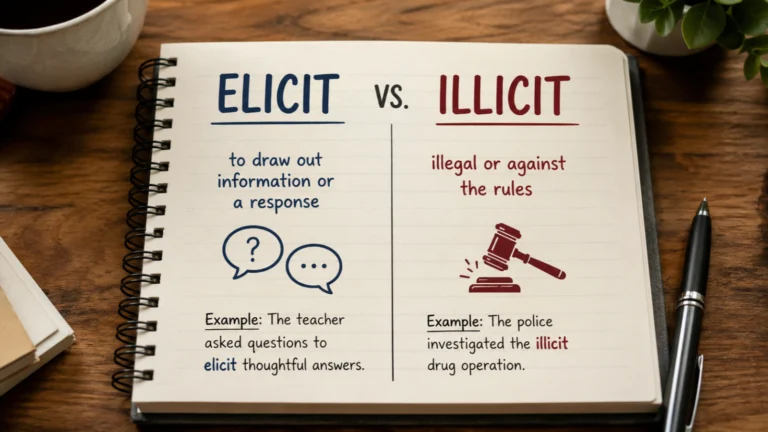
Elicit vs illicit is one of the most common word pairs that confuses English learners. Although these words sound almost the same, they have completely different meanings and are used in different situations. Mixing them up can change the meaning of your sentence and make your writing less clear.
The good news is that once you understand what each word means and where it belongs, remembering the difference becomes much easier. In this guide, you’ll learn the meanings of elicit and illicit, see practical examples, discover simple memory tricks, and test your understanding with easy exercises.
Table of Contents
- Introduction
- Why “Elicit” and “Illicit” Are Confusing
- Elicit vs Illicit Explained Simply
- Understanding Homophones in English
- What Are Homophones?
- Why Homophones Cause Confusion
- What Does “Elicit” Mean?
- What Does “Illicit” Mean?
- Elicit vs Illicit: Key Differences at a Glance
- How to Remember the Difference Between Elicit and Illicit
- Common Mistakes and Confusions
- Examples Section: Correct and Incorrect Usage
- Self Assessment: Test Your Knowledge
- Self Assessment Answers
- FAQs About “Elicit and Illicit”
- Final Conclusion: Using “Elicit” and “Illicit” Correctly
Why “Elicit” and “Illicit” Are Confusing
Many English learners accidentally use elicit when they mean illicit, or vice versa. There are several reasons why this happens.
Similar Pronunciation
The words sound very similar:
- Elicit → ih-LISS-it
- Illicit → ih-LISS-it
Because the pronunciation is almost identical, it is easy to hear one word and think of the other.
Similar Spelling
The words differ by only one letter at the beginning.
- Elicit
- Illicit
At a quick glance, they look nearly identical.
Context Confusion
People often encounter these words in formal writing, news reports, legal documents, or academic texts. Without knowing their meanings, it is easy to choose the wrong one.
Common Learner Mistakes
Some learners think both words mean “illegal.”
Others believe both refer to “getting information.”
Neither assumption is correct.
Elicit vs Illicit Explained Simply
Elicit means to bring out, draw out, or obtain a response or information, while illicit means illegal or not allowed by law or society.
One-Line Distinction
Elicit is an action (verb), while illicit describes something illegal (adjective).
Example Sentences
Elicit
- The teacher asked questions to elicit thoughtful answers.
- The survey helped elicit honest opinions.
Illicit
- Police uncovered an illicit drug operation.
- The company was fined for illicit business practices.
Understanding Homophones in English
What Are Homophones?
Homophones are words that sound the same or almost the same but have different meanings and spellings.
Example:
- Flower
- Flour
Although they sound alike, they refer to completely different things.
Why Homophones Cause Confusion
English contains many similar-sounding words. When learners hear them in conversation, they may not know which spelling or meaning is correct.
For example:
- Their
- There
- They’re
The pronunciation is similar, but each word has its own purpose.
The same is true for elicit and illicit.
What Does “Elicit” Mean?
Definition and Core Meaning
Elicit is a verb.
It means to bring out, draw out, or obtain information, emotions, reactions, or responses from someone.
Instead of forcing something, you encourage it to appear naturally.
Origin and Historical Use
The word elicit comes from the Latin word elicere, meaning “to draw out.”
It entered English in the 17th century and has long been used in education, psychology, communication, and research.
Modern Usage and Synonyms
Today, elicit commonly appears in:
- Education
- Interviews
- Psychology
- Business meetings
- Surveys
- Research
Common synonyms:
- Draw out
- Obtain
- Bring out
- Evoke
- Prompt
- Encourage
Key Points
- It is always a verb.
- It involves getting information or a reaction.
- It usually refers to communication.
Example Sentences
- Good interviewers know how to elicit detailed answers.
- The movie managed to elicit tears from the audience.
- Her question helped elicit useful feedback.
- The scientist designed the experiment to elicit accurate results.
What Does “Illicit” Mean?
Definition and Core Meaning
Illicit is an adjective.
It describes something illegal, forbidden, or morally unacceptable.
Origin and Historical Context
The word comes from the Latin illicitus, meaning not permitted.
For centuries, it has been used in legal and formal English to describe unlawful activities.
Modern Usage and Synonyms
Today, illicit often appears in discussions about:
- Crime
- Law
- Government
- Business
- Ethics
Common synonyms:
- Illegal
- Unlawful
- Forbidden
- Criminal
- Unauthorized
- Prohibited
Key Points
- It is always an adjective.
- It describes illegal activities or objects.
- It often appears in legal writing.
Example Sentences
- Authorities seized illicit goods.
- He was arrested for illicit trading.
- The investigation exposed an illicit financial scheme.
- Customs officers stopped the illicit shipment.
Elicit vs Illicit: Key Differences at a Glance
| Word | Part of Speech | Meaning | Example Context |
|---|---|---|---|
| Elicit | Verb | To draw out or obtain a response | The coach tried to elicit honest feedback. |
| Illicit | Adjective | Illegal or forbidden | Police investigated illicit activities. |
How to Remember the Difference Between Elicit and Illicit
Learning a simple memory trick can help you remember these words forever.
Easy Memory Tricks
Elicit = Extract
Both elicit and extract begin with the letter E.
Think:
Elicit = Extract information
Illicit = Illegal
Both illicit and illegal begin with Il-.
Think:
Illicit = Illegal
Association Technique
Imagine a detective.
The detective asks questions to elicit a confession.
The confession is about an illicit crime.
This story links both words together in a memorable way.
One Memorable Example
“The detective tried to elicit information about the illicit business.”
Common Mistakes and Confusions
Wrong
She tried to illicit an answer.
Correct
She tried to elicit an answer.
Explanation: Getting an answer is an action, so you need the verb elicit.
Wrong
The company was involved in elicit trade.
Correct
The company was involved in illicit trade.
Explanation: Illegal trade is described with the adjective illicit.
Wrong
The survey was designed to illicit opinions.
Correct
The survey was designed to elicit opinions.
Explanation: Surveys obtain responses, so elicit is correct.
Wrong
Police discovered an elicit operation.
Correct
Police discovered an illicit operation.
Explanation: The operation was illegal, not “obtained.”
Examples Section: Correct and Incorrect Usage
Example 1
✔ Correct: The teacher asked questions to elicit discussion.
✘ Incorrect: The teacher asked questions to illicit discussion.
Example 2
✔ Correct: Customs officers stopped illicit imports.
✘ Incorrect: Customs officers stopped elicit imports.
Example 3
✔ Correct: Her speech managed to elicit applause.
✘ Incorrect: Her speech managed to illicit applause.
Example 4
✔ Correct: The police investigated illicit gambling.
✘ Incorrect: The police investigated elicit gambling.
Self Assessment: Test Your Knowledge
Fill in the blanks with elicit or illicit.
1.
The interviewer hoped to ______ honest responses.
2.
The government is cracking down on ______ trade.
3.
The speech managed to ______ strong emotions.
4.
Police uncovered an ______ drug network.
Self Assessment Answers
- elicit
- illicit
- elicit
- illicit
FAQs About “Elicit and Illicit”
Is elicit the same as illicit?
No. Elicit means to draw out a response, while illicit means illegal or forbidden.
Is elicit a verb or an adjective?
Elicit is always a verb.
Is illicit always illegal?
Most of the time, yes. It refers to something forbidden by law or accepted rules.
Can illicit be used as a verb?
No. Illicit is only an adjective.
How do I remember the difference?
Remember:
- Elicit = Extract information
- Illicit = Illegal activity
Can elicit describe emotions?
Yes. You can elicit emotions, reactions, opinions, laughter, smiles, or responses.
Why do these words sound alike?
They are near-homophones. Their pronunciation is very similar even though their meanings are completely different.
Final Conclusion: Using “Elicit” and “Illicit” Correctly
Understanding the difference between elicit and illicit is easier than it first appears. Although these words sound almost identical, they serve entirely different purposes in English. Elicit is a verb that means to draw out information, emotions, ideas, or responses from someone. It is commonly used in conversations, interviews, classrooms, surveys, and research. Illicit, on the other hand, is an adjective that describes something illegal, forbidden, or not approved by law or accepted rules. It often appears in news reports, legal writing, and discussions about crime or unethical behavior.
A simple memory trick can make the distinction stick. Think of elicit as extract, since both begin with E and involve getting something from someone. Then remember that illicit starts with Il-, just like illegal, making it easy to connect the word with unlawful actions. Reading authentic examples, practicing with sentences, and noticing how these words appear in context will help reinforce the difference over time.
Every new vocabulary pair you master strengthens your confidence in English. By learning when to use elicit and when to use illicit, you’ll communicate more accurately, avoid common mistakes, and write with greater clarity. Keep practicing, revisit these examples whenever needed, and you’ll soon use both words naturally and correctly in everyday English.