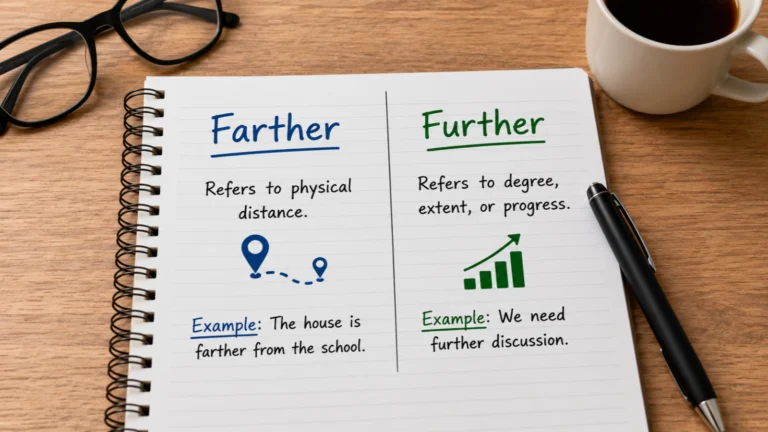
Farther vs Further is one of the most common word pairs that confuses English learners and even native speakers. Although these two words look and sound similar, they are used in different situations.
In most cases, farther vs further comes down to whether you are talking about physical distance or a figurative idea such as time, progress, or additional information. Understanding this small difference can make your writing more accurate, natural, and professional. In this guide, you’ll learn the meanings, grammar rules, pronunciation, real-life examples, memory tricks, and common mistakes.
By the end, you’ll know exactly when to use farther and when further, helping you communicate with greater confidence in both speaking and writing.
Table of Contents
- Introduction
- Why “Farther” and “Further” Are Confusing
- Farther vs Further Explained Simply
- Understanding Homophones in English
- What Are Homophones?
- Why Homophones Cause Confusion
- What Does “Farther” Mean?
- What Does “Further” Mean?
- Farther vs Further: Key Differences at a Glance
- How to Remember the Difference Between Farther and Further
- Common Mistakes and Confusions
- Examples Section: Correct and Incorrect Usage
- Self Assessment: Test Your Knowledge
- Self Assessment Answers
- FAQs About “Farther and Further”
- Final Conclusion: Using “Farther” and “Further” Correctly
Why “Farther” and “Further” Are Confusing
Many people use farther and further as if they mean exactly the same thing. While they can overlap in some situations, they usually have different purposes.
Similar Pronunciation
Both words sound almost identical in everyday English. Because of this, it is difficult for learners to recognize which one a speaker is using.
Similar Spelling
The only difference in spelling is one letter: farther contains far, while further contains fur. This small spelling difference is easy to overlook.
Context Confusion
Some dictionaries accept further in places where farther could also be used. This flexibility makes learners unsure about which word is preferred.
Common Learner Mistakes
Common mistakes include:
- Using further for physical distance when farther is clearer.
- Using farther when talking about ideas or progress.
- Assuming both words always have exactly the same meaning.
Fortunately, remembering one simple rule makes the difference much easier.
Farther vs Further Explained Simply
Farther means physical distance, while further means a greater degree, additional amount, or advancement.
One-Line Distinction
Farther is usually about measurable distance, while further is usually about figurative distance, time, progress, or extra information.
Examples
Farther
- We walked farther than we planned.
- The gas station is farther down the road.
Further
- We need further discussion before making a decision.
- She wants to continue her education further.
Understanding Homophones in English
What Are Homophones?
Homophones are words that sound the same or nearly the same but have different meanings and sometimes different spellings.
Example:
- Their
- There
Although they sound alike, they have different meanings.
Why Homophones Cause Confusion
English contains many words with similar pronunciation. Learners often choose the wrong spelling because they focus on how the word sounds rather than its meaning.
For example:
- “I want to know more.”
- “The boat is tied to the moor.”
The pronunciation is similar, but the meanings are completely different.
Although farther and further are not perfect homophones for every speaker, they are pronounced so similarly that many learners treat them like one pair.
What Does “Farther” Mean?
Definition and Core Meaning
Farther refers to a greater physical distance.
It answers questions like:
- How far?
- How much farther?
- Which place is farther away?
It usually describes measurable distance between locations or objects.
Origin and Historical Use
The word farther comes from the Old English word feorr, meaning “far.” Over time, it developed into the comparative form used specifically for physical distance.
Traditionally, writers have used farther when discussing actual measurable locations.
Modern Usage and Synonyms
Today, farther is still the preferred word for physical distance.
Synonyms
- More distant
- Beyond
- At a greater distance
- More remote
Examples
- Their house is farther from town than ours.
- We drove farther than expected.
- The hiking trail continues farther into the forest.
- Can you throw the ball farther?
What Does “Further” Mean?
Definition and Core Meaning
Further usually means:
- More
- Additional
- To a greater degree
- To advance
- Beyond the current point
It often refers to ideas, progress, education, discussions, research, or time rather than physical distance.
Origin and Historical Context
Like farther, further has ancient English roots. Over centuries, it developed broader meanings that went beyond physical distance.
Today, it is commonly used for abstract ideas and also functions as multiple parts of speech.
Modern Usage and Synonyms
Depending on context, further can mean:
- Additional
- Extra
- More
- Advance
- Promote
Examples
- We need further evidence.
- Please contact us for further information.
- She hopes to further her career.
- Further investigation revealed new facts.
Farther vs Further: Key Differences at a Glance
| Word | Part of Speech | Meaning | Example Context |
|---|---|---|---|
| Farther | Adjective, Adverb | Greater physical distance | The school is farther away. |
| Further | Adjective, Adverb, Verb | Additional, greater degree, advancement | We need further explanation. |
Quick Summary
| Use | Correct Word |
|---|---|
| Physical distance | Farther |
| Additional information | Further |
| Career progress | Further |
| Education | Further |
| Road distance | Farther |
How to Remember the Difference Between Farther and Further
A simple memory trick can help you remember these words forever.
Easy Memory Tricks
Trick 1: Look for “Far”
The word farther contains far.
Think:
Far = physical distance
If you can measure the distance, choose farther.
Trick 2: Think of “Further Information”
You often hear:
- Further details
- Further questions
- Further study
These are not physical distances.
Association Technique
Imagine standing on a road.
- Walking another mile = farther
- Learning another lesson = further
Memorable Example
- We walked farther down the beach.
- We discussed the problem further afterward.
One sentence is about distance.
The other is about continuing a discussion.
Common Mistakes and Confusions
Mistake 1
Wrong:
She lives further than I do.
Correct:
She lives farther than I do.
Explanation:
This is physical distance.
Mistake 2
Wrong:
We need farther information.
Correct:
We need further information.
Explanation:
Information cannot be measured by physical distance.
Mistake 3
Wrong:
The meeting needs farther discussion.
Correct:
The meeting needs further discussion.
Explanation:
Discussion is abstract.
Mistake 4
Wrong:
We drove further down the highway.
Preferred:
We drove farther down the highway.
Explanation:
Highway distance is physical.
Examples Section: Correct and Incorrect Usage
Example 1
✔ Correct: We walked farther than yesterday.
✘ Incorrect: We walked further than yesterday.
Example 2
✔ Correct: Further research is necessary.
✘ Incorrect: Farther research is necessary.
Example 3
✔ Correct: The hotel is farther from the airport.
✘ Incorrect: The hotel is further from the airport.
Example 4
✔ Correct: She wants to further her education.
✘ Incorrect: She wants to farther her education.
Example 5
✔ Correct: We cannot continue without further instructions.
✘ Incorrect: We cannot continue without farther instructions.
Example 6
✔ Correct: The hikers traveled farther into the mountains.
✘ Incorrect: The hikers traveled further into the mountains.
Self Assessment: Test Your Knowledge
Fill in each blank with farther or further.
1.
The library is ________ from my house than the supermarket.
2.
We need ________ evidence before making a final decision.
3.
The children ran ________ than their parents.
4.
She hopes to ________ her career by earning another degree.
Self Assessment Answers
- Farther
- Further
- Farther
- Further
FAQs About “Farther and Further”
1. Is farther or further more correct?
Both are correct. The best choice depends on the context. Farther usually refers to physical distance, while further refers to additional information, progress, or abstract ideas.
2. Can further mean physical distance?
Yes. Many modern dictionaries accept further for physical distance. However, farther is generally preferred when the distance can be measured.
3. Which word should I use in formal writing?
For clear and precise writing, use farther for measurable distance and further for abstract meanings or additional information.
4. Is “further information” correct?
Yes. “Further information” is a very common and correct English expression.
5. Is “farther education” correct?
No. The correct phrase is further education, because education refers to advancement rather than physical distance.
6. Why do native speakers sometimes use them interchangeably?
Language changes over time, and many native speakers use further in place of farther, especially in casual conversation. Even so, keeping the traditional distinction makes your writing clearer.
7. Which word is easier to remember?
Remember this simple rule:
Far = Farther = Physical distance
Everything else is usually Further.
Final Conclusion: Using “Farther” and “Further” Correctly
Learning the difference between farther and further may seem challenging at first, but it becomes much easier once you understand their main purposes. As a general rule, farther is the better choice when you are talking about measurable physical distance, such as roads, buildings, or travel. Further, on the other hand, is the word to use when discussing additional information, continued progress, deeper understanding, education, research, or anything abstract. Although modern English sometimes allows further to describe physical distance, following the traditional distinction will make your writing more precise and professional.
A helpful memory trick is to focus on the word far inside farther. If you can measure the distance in miles, meters, or steps, farther is usually the correct choice. If you’re talking about ideas, plans, conversations, or advancement, think of further as meaning “more” or “additional.” Reading books, paying attention to how these words appear in everyday writing, and practicing with your own sentences will help reinforce the difference over time.
Every new grammar rule you master makes your English stronger and more confident. Keep practicing, review real-world examples whenever you can, and don’t worry if you occasionally make mistakes. With regular use, choosing between farther and further will soon become second nature, helping you communicate with greater clarity in both speech and writing.