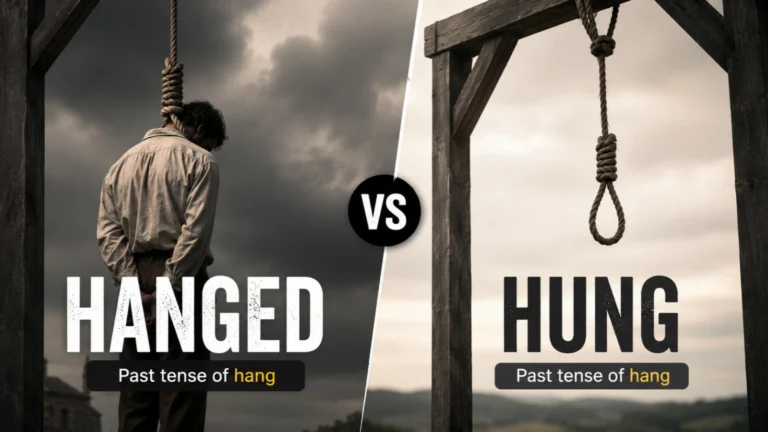
Hanged vs hung is one of the most common grammar questions English learners ask. At first glance, these two words seem interchangeable because they both come from the verb hang. However, people use each one in different situations, and choosing the wrong one can change the meaning of your sentence. While native speakers sometimes make mistakes too, learning the correct usage is easier than you might think. In this guide, you’ll discover the difference between hanged and hung, learn when each word is correct, explore their history, and practice with examples so you can use them confidently in both speaking and writing.
Table of Contents
- Introduction
- Why “Hanged” and “Hung” Are Confusing
- Hanged vs Hung Explained Simply
- Understanding Homophones in English
- What Are Homophones?
- Why Homophones Cause Confusion
- What Does “Hanged” Mean?
- What Does “Hung” Mean?
- Hanged vs Hung: Key Differences at a Glance
- How to Remember the Difference Between Hanged and Hung
- Common Mistakes and Confusions
- Examples Section: Correct and Incorrect Usage
- Self Assessment: Test Your Knowledge
- Self Assessment Answers
- FAQs About “Hanged and Hung”
- Final Conclusion: Using “Hanged” and “Hung” Correctly
Why “Hanged” and “Hung” Are Confusing
Many English learners struggle with hanged and hung because both words are past forms of the verb hang. Although they sound similar and share the same spelling except for their endings, they are not always interchangeable.
Here are the main reasons people confuse them:
- Similar pronunciation: Both words begin with the same sound, making them easy to mix up.
- Similar spelling: Only the endings differ, so learners often assume they have the same meaning.
- Context confusion: Both words describe something being suspended, but one has a special legal meaning in legal contexts.
- Common learner mistakes: Many people use hung when referring to executions, even though hanged is the correct choice.
Fortunately, once you understand the rule, remembering it becomes much easier.
Hanged vs Hung Explained Simply
The easiest way to understand the difference is this:
We use hanged when people execute someone by hanging, while we use hung when someone suspends or places something above the ground.
One-line distinction
Use hanged for executions; use hung for everything else.
Examples
- The criminal was hanged after the court’s decision.
- She hung a beautiful painting on the living room wall.
Understanding Homophones in English
What Are Homophones?
Homophones are words that sound the same but have different meanings or spellings.
Example:
- Sea – a large body of salt water
- See – to look at something
Although hanged and hung are not true homophones, they are often grouped among confusing English word pairs because of their close pronunciation and shared origin.
Why Homophones Cause Confusion
English contains many words that sound alike but have different meanings. Learners often choose the wrong word because they rely on pronunciation rather than context.
For example:
- I see the ocean.
- The sea is calm today.
Similarly, choosing hung instead of hanged changes the meaning of a sentence.
What Does “Hanged” Mean?
Definition and Core Meaning
Hanged is the past tense and past participle of hang when referring to execution by hanging.
It is used almost exclusively in legal, historical, or literary contexts.
Origin and Historical Use
The word comes from Old English and has been used for centuries in descriptions of judicial executions. Over time, English kept hanged only for this specific meaning, while hung became the standard form in every other situation.
Modern Usage and Synonyms
Modern English uses hanged mainly when discussing:
- Legal executions
- Historical events
- Fictional stories involving execution
Synonyms (depending on context):
- Executed
- Put to death
- Sentenced to death
Example Sentences
- The prisoner was hanged for treason.
- According to history, several pirates were hanged in the eighteenth century.
- The judge ordered that the convicted murderer be hanged.
What Does “Hung” Mean?
Definition and Core Meaning
Hung is the regular past tense and past participle of hang in almost every everyday situation.
It means to suspend, attach, or place something so it hangs freely.
Origin and Historical Context
The word has existed in English for hundreds of years. As the language evolved, hung became the preferred past form for ordinary actions involving objects, decorations, clothing, and many expressions.
Modern Usage and Synonyms
Today, hung is used in everyday conversation.
Common situations include:
- Hanging pictures
- Hanging clothes
- Hanging lights
- Hanging decorations
- Hanging curtains
Synonyms:
- Suspended
- Attached
- Displayed
- Draped
- Mounted
Example Sentences
- She hung her coat by the door.
- We hung colorful lights around the garden.
- They hung family photographs in the hallway.
Hanged vs Hung: Key Differences at a Glance
| Word | Part of Speech | Meaning | Example Context |
|---|---|---|---|
| Hanged | Verb (past tense/past participle) | Executed by hanging | The criminal was hanged. |
| Hung | Verb (past tense/past participle) | Suspended or attached | She hung the picture on the wall. |
How to Remember the Difference Between Hanged and Hung
Remembering this grammar rule is surprisingly simple.
Easy Memory Tricks
- Hanged = Human execution
- Hung = Home, decorations, pictures, clothes, lights
Notice that Hanged and Human both begin with H.
Association Technique
Think of a courtroom.
If the sentence talks about a legal punishment, use hanged.
If the sentence talks about an object, decoration, or everyday action, use hung.
Memorable Example
- The picture was hung.
- The prisoner was hanged.
One refers to an object.
The other refers to an execution.
Common Mistakes and Confusions
Here are mistakes learners frequently make.
Wrong
❌ The thief was hung yesterday.
Correct
✅ The thief was hanged yesterday.
Explanation: Executions require hanged.
Wrong
❌ She hanged a mirror in her bedroom.
Correct
✅ She hung a mirror in her bedroom.
Explanation: Mirrors are objects, so use hung.
Wrong
❌ They hanged Christmas lights outside.
Correct
✅ They hung Christmas lights outside.
Wrong
❌ We hanged our coats by the entrance.
Correct
✅ We hung our coats by the entrance.
Examples Section: Correct and Incorrect Usage
Example 1
✔ Correct: We hung new curtains yesterday.
✘ Incorrect: We hanged new curtains yesterday.
Example 2
✔ Correct: The painting was hung above the fireplace.
✘ Incorrect: The painting was hanged above the fireplace.
Example 3
✔ Correct: The convicted criminal was hanged.
✘ Incorrect: The convicted criminal was hung.
Example 4
✔ Correct: She hung her backpack on the hook.
✘ Incorrect: She hanged her backpack on the hook.
Example 5
✔ Correct: The decorations were hung before the party.
✘ Incorrect: The decorations were hanged before the party.
Self Assessment: Test Your Knowledge
Fill in each blank with hanged or hung.
- The family ______ beautiful artwork in the dining room.
- According to the old records, the pirate was ______.
- She ______ her jacket on the chair.
- The Christmas lights were ______ across the street.
Self Assessment Answers
- Hung
- Hanged
- Hung
- Hung
FAQs About “Hanged and Hung”
Is “hung” grammatically correct?
Yes. Hung is correct for almost every ordinary use of the verb hang, such as pictures, clothes, lights, and decorations.
When should I use “hanged”?
Use hanged only when talking about a person who was executed by hanging.
Can I say “the picture was hanged”?
No. The correct sentence is The picture was hung.
Why are there two past tense forms of “hang”?
English kept hanged for executions while hung became the standard past form for all other meanings.
Do native English speakers confuse these words?
Sometimes they do, especially in casual writing. However, formal English follows the traditional rule.
Is “hung” more common than “hanged”?
Yes. Since most conversations involve everyday objects rather than executions, hung appears far more frequently.
Is this rule the same in American and British English?
Yes. Both American and British English generally follow the same distinction.
Final Conclusion: Using “Hanged” and “Hung” Correctly
Understanding the difference between hanged and hung is an excellent example of how small grammar rules can make a big difference in clear communication. Although both words come from the same verb, they are not used in the same way. Hung is the everyday choice whenever you talk about pictures, clothes, decorations, signs, curtains, lights, or anything else that is suspended. Hanged, on the other hand, has a very specific meaning and is reserved for situations involving execution by hanging. Keeping this distinction in mind helps your writing sound accurate, natural, and professional.
A simple memory trick can make the rule stick: Hanged is for humans in legal executions, while hung is for everything you hang around your home or workplace. The more you read and practice, the more automatic this choice will become. Whenever you’re unsure, ask yourself whether the sentence describes an execution or an ordinary object. If it’s an object, hung is almost certainly correct. If it’s an execution, choose hanged. With regular practice, you’ll quickly master this commonly confused pair and feel more confident using English in conversations, academic writing, and professional communication. Every grammar rule you learn brings you one step closer to becoming a stronger and more fluent English speaker.