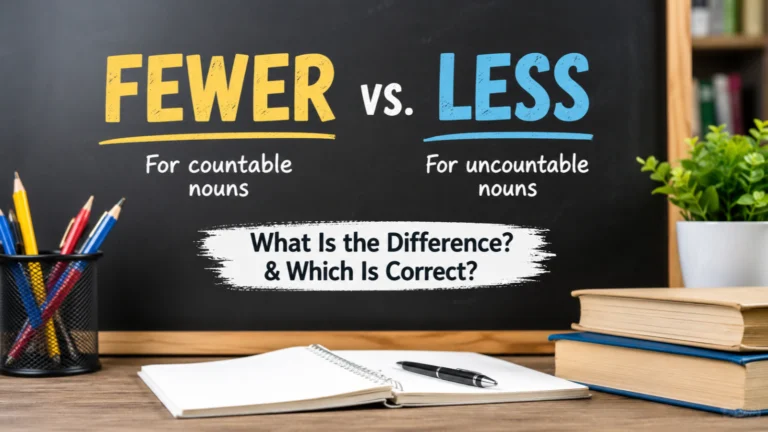
Fewer vs less is one of the most common grammar questions among English learners. Although these two words seem similar and both refer to a smaller amount of something, they are not always interchangeable. Many native speakers also mix them up in everyday conversation, making the confusion even greater. Learning when to use fewer and less correctly will improve your writing, speaking, and overall confidence in English. Fortunately, the rule is simple once you understand it. In this guide, you’ll learn the difference between fewer and less, see plenty of examples, discover common mistakes, and pick up easy memory tricks that will help you use both words correctly every time.
Table of Contents
- Introduction
- Why “Fewer” and “Less” Are Confusing
- Fewer vs Less Explained Simply
- Understanding Homophones in English
- What Are Homophones?
- Why Homophones Cause Confusion
- What Does “Fewer” Mean?
- What Does “Less” Mean?
- Fewer vs Less: Key Differences at a Glance
- How to Remember the Difference Between Fewer and Less
- Common Mistakes and Confusions
- Examples Section: Correct and Incorrect Usage
- Self Assessment: Test Your Knowledge
- Self Assessment Answers
- FAQs About “Fewer and Less”
- Final Conclusion: Using “Fewer” and “Less” Correctly
Why “Fewer” and “Less” Are Confusing
Many English learners struggle with fewer and less because both words express a reduction in quantity. However, they are used with different kinds of nouns.
Here are the main reasons for the confusion:
Similar Pronunciation
Both words are short, commonly used, and often appear in similar sentence structures, making them easy to mix up while speaking.
Similar Spelling
Although the spellings are different, both are short comparative words that frequently appear together in grammar lessons.
Context Confusion
People often hear phrases like “10 items or less” in stores, even though traditional grammar recommends “10 items or fewer.” Everyday speech doesn’t always follow formal grammar rules.
Common Learner Mistakes
Learners often use less for countable nouns or fewer for uncountable nouns because both mean “a smaller quantity.”
Examples of common mistakes include:
- Less books ❌
- Fewer water ❌
- Less apples ❌
Fewer vs Less Explained Simply
The easiest rule is this:
Fewer is used with things you can count.
Less is used with things you cannot count individually.
One-Line Distinction
Fewer means a smaller number of countable things, while less means a smaller amount of something uncountable.
Examples
Fewer
- There are fewer students in class today.
- We bought fewer oranges this week.
Less
- I need less sugar in my coffee.
- She spends less time watching television.
Understanding Homophones in English
What Are Homophones?
Homophones are words that sound the same but have different meanings and spellings.
Example:
- Their
- There
- They’re
Although fewer and less are not homophones, learners often confuse them because they express similar ideas.
Why Homophones Cause Confusion
Words that sound alike or have related meanings can easily be mixed up.
For example:
- Your welcome ❌
- You’re welcome ✔
Similarly, learners may incorrectly choose between fewer and less because both describe smaller quantities.
What Does “Fewer” Mean?
Definition and Core Meaning
Fewer means a smaller number of things that can be counted individually.
If you can count each item one by one, fewer is usually the correct choice.
Origin and Historical Use
The word fewer comes from Old English and has long been used to compare numbers of countable objects. Traditional English grammar has consistently distinguished it from less.
Modern Usage and Synonyms
Common synonyms include:
- Not as many
- A smaller number of
- Reduced number
Use “Fewer” With
- Books
- Cars
- Students
- Apples
- Chairs
- People
- Mistakes
Example Sentences
- Fewer people attended the meeting this year.
- We made fewer errors after practicing.
- The new library has fewer printed books than before.
- There are fewer birds in the park during winter.
What Does “Less” Mean?
Definition and Core Meaning
Less means a smaller amount of something that cannot usually be counted individually.
It refers to mass nouns or uncountable nouns.
Origin and Historical Context
The word less has been part of English for centuries and traditionally refers to quantity rather than number.
Modern Usage and Synonyms
Common synonyms include:
- A smaller amount of
- Not as much
- Reduced quantity
Use “Less” With
- Water
- Money
- Time
- Milk
- Sand
- Air
- Information
Example Sentences
- I have less free time now.
- Please add less salt to the soup.
- We used less fuel than expected.
- Drinking less coffee helped me sleep better.
Fewer vs Less: Key Differences at a Glance
| Word | Part of Speech | Meaning | Example Context |
|---|---|---|---|
| Fewer | Determiner/Adjective | Smaller number of countable things | Fewer students came today. |
| Less | Determiner/Adjective | Smaller amount of uncountable things | There is less water in the bottle. |
How to Remember the Difference Between Fewer and Less
Remember these simple tricks.
Memory Trick 1
If you can count the items one by one, use fewer.
- Three apples
- Five chairs
- Ten people
Memory Trick 2
If you measure it instead of counting it, use less.
- Water
- Sugar
- Milk
- Time
Association Technique
Think:
Fewer = Number
Less = Amount
Memorable Example
You can count cookies, so say:
Fewer cookies.
You cannot count milk without measuring it, so say:
Less milk.
This simple comparison helps most learners remember the rule instantly.
Common Mistakes and Confusions
Here are mistakes English learners often make.
Wrong
There are less chairs in the room.
Correct
There are fewer chairs in the room.
Explanation: Chairs can be counted.
Wrong
I need fewer water.
Correct
I need less water.
Explanation: Water is uncountable.
Wrong
She has less friends.
Correct
She has fewer friends.
Explanation: Friends are countable.
Wrong
We have fewer patience.
Correct
We have less patience.
Explanation: Patience is uncountable.
Examples Section: Correct and Incorrect Usage
Example 1
✔ Correct: We have fewer employees this year.
✘ Incorrect: We have less employees this year.
Example 2
✔ Correct: Please use less oil.
✘ Incorrect: Please use fewer oil.
Example 3
✔ Correct: Fewer cars are on the road today.
✘ Incorrect: Less cars are on the road today.
Example 4
✔ Correct: I spend less money on clothes now.
✘ Incorrect: I spend fewer money on clothes now.
Example 5
✔ Correct: There are fewer mistakes in your essay.
✘ Incorrect: There are less mistakes in your essay.
Example 6
✔ Correct: She drinks less coffee than before.
✘ Incorrect: She drinks fewer coffee than before.
Self Assessment: Test Your Knowledge
Choose fewer or less.
- We need ________ water for the recipe.
- There are ________ students in today’s class.
- She spends ________ money on travel.
- I made ________ spelling mistakes this time.
Self Assessment Answers
- Less
- Fewer
- Less
- Fewer
FAQs About “Fewer and Less”
1. What is the main difference between fewer and less?
Fewer is used for countable nouns, while less is used for uncountable nouns.
2. Can I say “less people”?
In formal English, fewer people is considered correct because people can be counted.
3. Why do supermarkets say “10 items or less”?
This phrase has become common in everyday English, but many grammar experts prefer 10 items or fewer.
4. Is it ever acceptable to use less with countable nouns?
In informal English, yes. Expressions involving time, distance, money, or measurements often use less, such as “less than five miles” or “less than twenty dollars.”
5. How can I quickly remember which word to use?
Ask yourself whether you can count the noun individually. If yes, use fewer. If not, use less.
6. Do native English speakers confuse fewer and less?
Yes. Even native speakers sometimes use them interchangeably in casual conversation, although formal writing usually follows the traditional grammar rule.
7. Is the rule the same in American and British English?
Yes. Both American and British English generally follow the same grammar rule, though informal speech may vary.
Final Conclusion: Using “Fewer” and “Less” Correctly
Understanding the difference between fewer and less is one of the simplest ways to make your English sound clearer and more accurate. The key idea is easy to remember: use fewer for things you can count and less for things you cannot count individually. Once you begin thinking about whether a noun is countable or uncountable, choosing the correct word becomes much easier. Although you’ll sometimes hear less used with countable nouns in everyday conversation or on store signs, following the traditional grammar rule is the best choice for formal writing, academic work, business communication, and exams.
Practice is the fastest way to master this grammar point. As you read books, newspapers, and online articles, notice how experienced writers use fewer and less in different situations. Try creating your own sentences and checking whether the noun is something you can count one by one or something measured as a whole. Over time, this habit will become automatic.
Remember the simple formula: Fewer = number. Less = amount. Keeping this memory trick in mind will help you avoid one of the most common English grammar mistakes. With regular practice and careful attention, you’ll soon use fewer and less naturally and confidently in both speaking and writing.