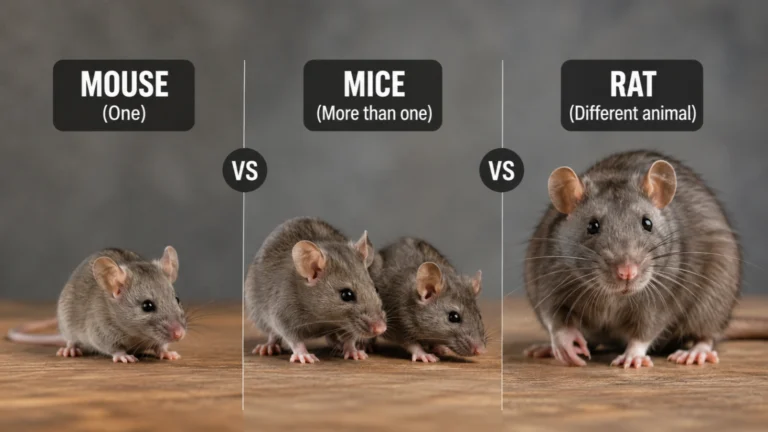
Mice vs Rat vs Mouse can be confusing because these three terms are often used interchangeably, even though they refer to different rodents. Understanding the Mice vs Rat vs Mouse distinction is important for English learners, students, writers, and anyone who wants to use the correct word in everyday conversations or writing. While mouse is the singular form and mice is its irregular plural, rat refers to a different species that is generally larger and has unique physical and behavioral traits.
In this guide, you’ll learn the meaning of each word, their key differences, pronunciation, grammar rules, and practical examples. By the end, you’ll know exactly when to use mouse, mice, or rat with confidence.
Table of Contents
- Introduction
- Why “Mice,” “Rat,” and “Mouse” Are Confusing
- Mice vs Rat vs Mouse Explained Simply
- Understanding Related English Word Forms
- What Are Irregular Plurals?
- Why They Cause Confusion
- What Does “Mouse” Mean?
- What Does “Mice” Mean?
- What Does “Rat” Mean?
- Mice vs Rat vs Mouse: Key Differences at a Glance
- How to Remember the Difference
- Common Mistakes and Confusions
- Examples: Correct and Incorrect Usage
- Self Assessment: Test Your Knowledge
- Self Assessment Answers
- FAQs About Mice, Rat, and Mouse
- Final Conclusion
Why “Mice,” “Rat,” and “Mouse” Are Confusing
Many learners assume these words all describe the same animal. While they belong to the rodent family, they have different meanings and uses in English.
Similar Pronunciation
The words mouse and mice sound related because they are singular and plural forms of the same noun. Rat sounds different, but people often group it with them because both animals are rodents.
Similar Spelling
The spelling of mouse changes completely when it becomes plural.
- Mouse → Mice
Unlike regular nouns that simply add -s, this irregular plural surprises many learners.
Context Confusion
People often use “mouse” and “rat” casually when describing any small rodent, even though they are different animals.
Common Learner Mistakes
- Saying mouses instead of mice
- Calling every rodent a mouse
- Confusing rats with mice
- Using mice as a singular noun
Mice vs Rat vs Mouse Explained Simply
Mouse means one small rodent, while mice means more than one mouse. A rat is a different kind of rodent that is generally larger than a mouse.
One-Line Distinction
Mouse = one small rodent, Mice = more than one mouse, Rat = a different, usually larger rodent.
Example Sentences
- A mouse ran across the kitchen floor.
- Several mice were hiding behind the cupboard.
- A rat was spotted near the garbage bins.
- Farmers try to keep both rats and mice away from stored grain.
Understanding Related English Word Forms
Although this topic is not about homophones, it is important to understand irregular plurals, because mouse changes to mice instead of following the usual plural rule.
What Are Irregular Plurals?
An irregular plural is a noun that does not form its plural by simply adding -s or -es.
Examples include:
- Mouse → Mice
- Man → Men
- Woman → Women
- Tooth → Teeth
Why They Cause Confusion
Most English nouns follow predictable rules. Irregular plurals must be memorized because they change their spelling completely.
For example:
- Correct: Three mice were in the attic.
- Incorrect: Three mouses were in the attic.
What Does “Mouse” Mean?
Definition and Core Meaning
A mouse is a small rodent with a pointed nose, long tail, and rounded ears. The word also refers to the handheld device used to control a computer.
Origin and Historical Use
The word mouse comes from Old English mūs, which has been used for hundreds of years to describe the small animal. The computer device received the same name because its cord resembled a mouse’s tail.
Modern Usage and Synonyms
Depending on the context, mouse may refer to:
- A small rodent
- A computer pointing device
Possible synonyms (animal context):
- Small rodent
- Field mouse
- House mouse
Example Sentences
- I saw a mouse under the table.
- My computer mouse stopped working.
- The cat chased the mouse around the room.
What Does “Mice” Mean?
Definition and Core Meaning
Mice is the plural form of mouse.
It refers to two or more mice.
Origin and Historical Use
The plural mice developed naturally from older forms of English and has remained unchanged for centuries.
Modern Usage and Synonyms
It simply means multiple mice.
Examples include:
- House mice
- Field mice
- Baby mice
Example Sentences
- The old barn was full of mice.
- Scientists observed several mice during the experiment.
- We found mice in the storage room.
What Does “Rat” Mean?
Definition and Core Meaning
A rat is a rodent that is generally larger than a mouse. Rats have thicker bodies, stronger tails, and larger heads.
Origin and Historical Context
The word rat entered English during the Middle Ages and has long referred to larger rodents found in cities, farms, and forests.
Modern Usage and Synonyms
Common types include:
- Brown rat
- Black rat
- Pet rat
Related words:
- Rodent
- Vermin (depending on context)
Example Sentences
- A rat was hiding behind the trash can.
- Some people keep pet rats because they are intelligent.
- The farmer set traps to catch the rats.
Mice vs Rat vs Mouse: Key Differences at a Glance
| Word | Part of Speech | Meaning | Example Context |
|---|---|---|---|
| Mouse | Noun | One small rodent or a computer device | I saw a mouse in the kitchen. |
| Mice | Noun (Plural) | More than one mouse | Several mice lived in the attic. |
| Rat | Noun | A larger rodent, different from a mouse | A rat ran through the alley. |
How to Remember the Difference Between Mice and Rat and Mouse
Learning these words becomes much easier with a few simple memory tricks.
Easy Memory Tricks
- Mouse = one
- Mice = many
- Rat = larger rodent
Association Techniques
Imagine one tiny animal.
That is a mouse.
Now imagine five of them together.
Those are mice.
Now picture a noticeably larger rodent.
That is a rat.
One Memorable Example
One mouse becomes many mice—but never many mouses. A rat stays a rat because it is a different animal.
Common Mistakes and Confusions
Mistake 1
❌ I saw three mouses.
✔ I saw three mice.
Explanation: Mouse has an irregular plural.
Mistake 2
❌ Every small rodent is a rat.
✔ Some are mice, while others are rats.
Explanation: These are different species.
Mistake 3
❌ A mice is eating cheese.
✔ A mouse is eating cheese.
Explanation: Mice is plural.
Mistake 4
❌ The laboratory used one mice.
✔ The laboratory used one mouse.
Explanation: One requires the singular form.
Examples Section: Correct and Incorrect Usage
Example 1
✔ Correct: The mouse hid behind the sofa.
✘ Incorrect: The mice hid behind the sofa. (when referring to one animal)
Example 2
✔ Correct: The farmer caught several mice.
✘ Incorrect: The farmer caught several mouses.
Example 3
✔ Correct: The rat climbed into the drain.
✘ Incorrect: The mouse climbed into the drain. (if referring to a large rat)
Example 4
✔ Correct: My wireless mouse needs new batteries.
✘ Incorrect: My wireless rat needs new batteries.
Self Assessment: Test Your Knowledge
Fill in the blanks.
1.
I found one ________ in the kitchen.
2.
The scientist observed several ________ in the laboratory.
3.
A sewer ________ is usually larger than a mouse.
4.
My computer ________ is not working today.
Self Assessment Answers
- mouse
- mice
- rat
- mouse
FAQs About “Mice,” “Rat,” and “Mouse”
Is “mice” the plural of “mouse”?
Yes. Mice is the correct irregular plural of mouse.
Is “mouses” ever correct?
Usually no. In standard English, the plural of the animal is mice. In some technical computing contexts, “mouses” has occasionally been used informally for multiple computer devices, but mice remains the accepted and preferred plural in general English.
Are rats and mice the same animal?
No. They belong to the rodent family but are different species. Rats are generally larger and heavier than mice.
Can “mouse” refer to a computer device?
Yes. The same word is used for the handheld computer pointing device.
Why is the plural “mice” instead of “mouses”?
English has several irregular plurals that developed historically. Mouse follows one of these older patterns.
Which is bigger, a mouse or a rat?
A rat is usually much larger than a mouse.
How can I remember the correct plural?
Think of other irregular words like man → men and tooth → teeth. Similarly, mouse → mice.
Final Conclusion: Using “Mice,” “Rat,” and “Mouse” Correctly
Understanding the difference between mice, rat, and mouse is easier than it first appears. A mouse refers to one small rodent, while mice is simply the plural form of mouse. A rat, however, is not the plural of mouse—it is a different animal that is generally larger and has its own characteristics. Remembering this distinction will help you speak and write English more naturally.
One of the most common mistakes learners make is saying mouses instead of mice. Since mouse has an irregular plural, it follows a historical pattern rather than the usual -s rule. Keeping the simple phrase “one mouse, many mice” in mind is an excellent way to avoid this error. Also, remember that although rats and mice are both rodents, they should not be used as interchangeable words because they describe different animals.
Whether you’re reading books, writing essays, studying biology, or talking about computer equipment, choosing the correct word shows a stronger understanding of English. Practice using these words in everyday sentences, pay attention to their meanings in context, and review the examples whenever you’re unsure. With regular practice, you’ll quickly become confident in using mouse, mice, and rat correctly in both spoken and written English.