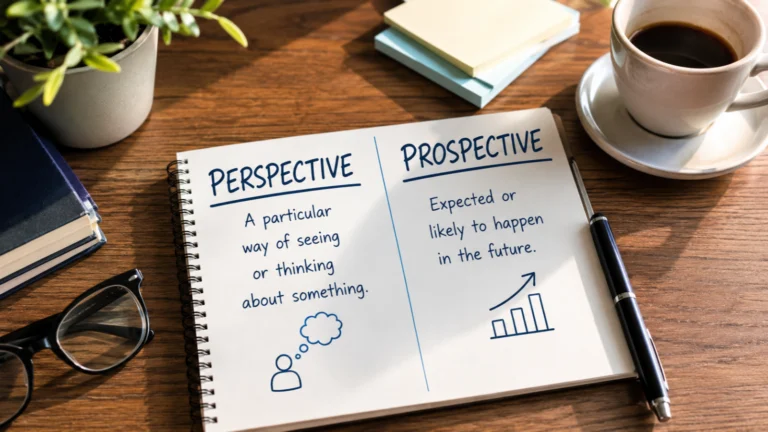
Perspective or Prospective are two commonly confused English words because they look and sound similar, yet they have completely different meanings. Many English learners, students, and even native speakers occasionally mix them up in writing and conversation. Understanding the difference is important because using the wrong word can change the meaning of a sentence and make your communication less clear. In this guide, you’ll learn what each word means, how they are used in different contexts, and simple tricks to remember the correct choice. With easy explanations, practical examples, and common mistakes to avoid, you’ll gain the confidence to use these words accurately in both everyday and professional English. By the end, Perspective or Prospective will no longer be a source of confusion.
Table of Contents
- Introduction
- Why “Perspective” and “Prospective” Are Confusing
- Perspective vs Prospective Explained Simply
- Understanding Homophones in English
- What Are Homophones?
- Why Homophones Cause Confusion
- What Does “Perspective” Mean?
- What Does “Prospective” Mean?
- Perspective vs Prospective: Key Differences at a Glance
- How to Remember the Difference Between Perspective and Prospective
- Common Mistakes and Confusions
- Examples Section: Correct and Incorrect Usage
- Self Assessment: Test Your Knowledge
- Self Assessment Answers
- FAQs About “Perspective and Prospective”
- Final Conclusion: Using “Perspective” and “Prospective” Correctly
Why “Perspective” and “Prospective” Are Confusing
Many learners accidentally mix up perspective and prospective because they share several similarities.
Similar Pronunciation
Both words begin with pers- and have nearly the same rhythm when spoken quickly. This makes them easy to confuse during conversations.
Similar Spelling
The words differ by only a few letters:
- Perspective
- Prospective
Because they look alike, people often type one when they actually mean the other.
Context Confusion
Both words appear in education, business, writing, and everyday English. Without understanding their meanings, learners may choose the wrong one.
For example:
- “A prospective employee”
- “A different perspective”
These phrases sound similar but mean entirely different things.
Common Learner Mistakes
People often:
- Write prospective instead of perspective
- Think both words relate to “thinking”
- Assume they can be used interchangeably
In reality, they cannot.
Perspective vs Prospective Explained Simply
Perspective means a particular way of seeing or thinking about something, while prospective means expected or likely to happen in the future.
One-Line Distinction
Perspective is about your viewpoint. Prospective is about the future.
Examples
Perspective
- Everyone has a different perspective on success.
- Try to see the problem from her perspective.
Prospective
- The company interviewed several prospective employees.
- She spoke with prospective students during the open day.
Understanding Homophones in English
What Are Homophones?
Homophones are words that sound the same or very similar but have different meanings and often different spellings.
Example:
- Sea
- See
Although perspective and prospective are not true homophones, they are close enough in pronunciation that learners often confuse them.
Why Homophones Cause Confusion
English contains many words with similar sounds. When learners hear them without context, they may choose the wrong spelling or meaning.
For example:
“I met several prospective buyers.”
Someone unfamiliar with the word may mistakenly write perspective buyers, which changes the meaning completely.
What Does “Perspective” Mean?
Definition and Core Meaning
Perspective is a noun that means a particular attitude, opinion, viewpoint, or way of understanding something.
It can also refer to the way objects appear in art or photography.
Origin and Historical Use
The word comes from the Latin perspectiva, meaning “to look through” or “to see clearly.”
Originally, it described visual depth in art before expanding to mean someone’s point of view.
Modern Usage and Synonyms
Common synonyms include:
- Viewpoint
- Opinion
- Outlook
- Angle
- Standpoint
- Frame of reference
Key Points
- It is usually a noun.
- It refers to how someone sees a situation.
- It can describe opinions or visual depth.
Example Sentences
- Your perspective helps me understand the issue better.
- The book offers a fresh perspective on history.
- From my perspective, honesty is always important.
- The artist used perspective to create depth.
What Does “Prospective” Mean?
Definition and Core Meaning
Prospective is an adjective meaning expected, potential, or likely to happen in the future.
It describes people, opportunities, or events that may exist later.
Origin and Historical Context
The word comes from the Latin prospectivus, meaning “looking forward.”
It has long been used to describe future possibilities.
Modern Usage and Synonyms
Common synonyms include:
- Potential
- Future
- Expected
- Likely
- Possible
- Upcoming
Key Points
- It is an adjective.
- It describes future possibilities.
- It often appears before nouns.
Example Sentences
- She met several prospective employers.
- The university welcomed prospective students.
- They are searching for prospective investors.
- Every prospective customer received a brochure.
Perspective vs Prospective: Key Differences at a Glance
| Word | Part of Speech | Meaning | Example Context |
|---|---|---|---|
| Perspective | Noun | A viewpoint or way of thinking | Everyone has a different perspective. |
| Prospective | Adjective | Expected or likely in the future | Prospective buyers visited the house. |
How to Remember the Difference Between Perspective and Prospective
Here are some simple tricks.
Easy Memory Tricks
Perspective = Point of View
Both words contain the letter P.
Think:
Perspective → Point of View
Prospective = Prospects for the Future
A prospect is a future possibility.
Therefore:
Prospective → Future
Association Techniques
Imagine someone wearing glasses.
- Glasses help you see your perspective.
Now imagine looking ahead on a road.
- You’re looking toward your prospective future.
Memorable Example
“My perspective changed after meeting my prospective employer.”
The first refers to a viewpoint.
The second refers to a future employer.
Common Mistakes and Confusions
Mistake 1
❌ I like your prospective on this topic.
✔ I like your perspective on this topic.
Explanation: Here you’re talking about someone’s opinion.
Mistake 2
❌ The school welcomed perspective students.
✔ The school welcomed prospective students.
Explanation: The students may attend in the future.
Mistake 3
❌ She shared her prospective during the meeting.
✔ She shared her perspective during the meeting.
Explanation: A viewpoint is a perspective.
Mistake 4
❌ They interviewed perspective employees.
✔ They interviewed prospective employees.
Explanation: These are potential future employees.
Examples Section: Correct and Incorrect Usage
Example 1
✔ Correct: Everyone has a unique perspective.
✘ Incorrect: Everyone has a unique prospective.
Example 2
✔ Correct: The company contacted prospective clients.
✘ Incorrect: The company contacted perspective clients.
Example 3
✔ Correct: Try to understand her perspective before judging.
✘ Incorrect: Try to understand her prospective before judging.
Example 4
✔ Correct: The university organized an event for prospective students.
✘ Incorrect: The university organized an event for perspective students.
Example 5
✔ Correct: Reading different books broadens your perspective.
✘ Incorrect: Reading different books broadens your prospective.
Example 6
✔ Correct: The manager spoke with prospective employees.
✘ Incorrect: The manager spoke with perspective employees.
Self Assessment: Test Your Knowledge
Fill in the blanks with perspective or prospective.
1.
The company welcomed several __________ employees.
2.
Your __________ helped me solve the problem.
3.
She met many __________ buyers during the exhibition.
4.
Reading history gives us a broader __________.
Self Assessment Answers
- Prospective
- Perspective
- Prospective
- Perspective
FAQs About “Perspective and Prospective”
1. Are perspective and prospective interchangeable?
No. They have different meanings and grammatical functions.
2. Is perspective a noun or an adjective?
Perspective is mainly a noun.
Example:
“His perspective was helpful.”
3. Is prospective always about the future?
Yes. It describes someone or something that is expected or likely in the future.
4. Can prospective describe people?
Yes.
Examples include:
- Prospective employee
- Prospective student
- Prospective buyer
- Prospective customer
5. How can I remember the difference easily?
Remember:
- Perspective = Point of View
- Prospective = Potential Future
6. Which word is used in business English more often?
Both are common, but they appear in different contexts.
- Perspective is used when discussing opinions or viewpoints.
- Prospective is used when referring to future employees, customers, clients, investors, or opportunities.
7. Why do English learners confuse these words?
Because they have similar spellings, similar pronunciation, and often appear in formal writing. Their meanings, however, are entirely different.
Final Conclusion: Using “Perspective” and “Prospective” Correctly
Although perspective and prospective look and sound alike, remembering their meanings is easier once you connect each word to its main idea. Perspective is all about a person’s viewpoint, opinion, or way of seeing a situation. Whenever you are talking about thoughts, understanding, or different ways of looking at something, perspective is the correct choice. Prospective, on the other hand, points toward the future. It describes someone or something that is expected, potential, or likely to exist later, such as a prospective employee, student, customer, or investor.