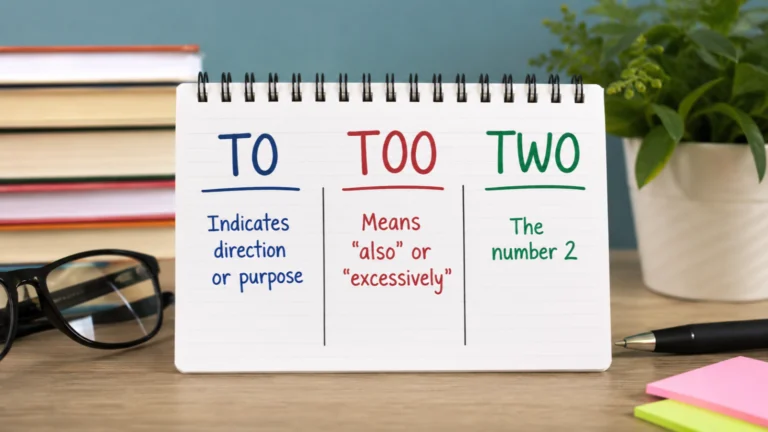
To vs Too vs Two is one of the most common grammar topics that confuses English learners because these three words sound exactly the same but have completely different meanings and uses. Understanding the difference between To vs Too vs Two is essential for writing clearly, avoiding common mistakes, and communicating confidently in both everyday conversations and formal writing. While to is mainly used as a preposition or part of an infinitive verb, too means “also” or “excessively,” and two refers to the number 2. Learning when to use each word correctly can greatly improve your grammar and writing accuracy. In this guide, we will explain To vs Too vs Two with simple definitions, easy examples, helpful tips, and practice sentences so you can use these commonly confused words with confidence.
Why “To,” “Too,” and “Two” Are Confusing
The words to, too, and two often confuse English learners because they are homophones, meaning they have the same pronunciation but different meanings and spellings.
Similar Pronunciation
All three words are pronounced as /tuː/. When listening to someone speak, it is impossible to know which word they mean without understanding the sentence.
Similar Spelling
Although the spellings are slightly different, the words are visually similar. The extra “o” in too and the “w” in two can easily be overlooked during writing.
Context Confusion
Each word serves a completely different purpose.
- To usually connects verbs or shows direction.
- Too means “also” or “more than enough.”
- Two refers to the number 2.
Without understanding the context, learners often choose the wrong spelling.
Common Learner Mistakes
Some common mistakes include:
- Writing too instead of to
- Using two when talking about direction
- Forgetting that too often means “also”
To vs Too vs Two Explained Simply
To means movement, direction, or forms the infinitive of a verb, while too means “also” or “excessively,” and two is the number 2.
One-line distinction
To shows direction or purpose, too means “also” or “more than enough,” while two represents a quantity.
Examples
To
- I want to learn English.
- She walked to the market.
Too
- I want too come. ✘
- I want to come. ✔
- She is too tired to study.
- I want to go too.
Two
- I have two brothers.
- Please buy two apples.
Understanding Homophones in English
What Are Homophones?
Homophones are words that sound the same but have different spellings and meanings.
Example:
- Sea
- See
Although they sound identical, they mean different things.
Why Homophones Cause Confusion
Homophones can make writing difficult because your ears cannot tell the difference.
For example:
i- “I have two books.”
ii- “I want to read.”
iii- “I want too.”
Each sentence uses a different word even though they sound exactly alike.
What Does “To” Mean?
Definition and Core Meaning
To is mainly a preposition or a part of the infinitive verb form.
It can show:
- Direction
- Destination
- Purpose
- Relationship
- Time
- Distance
Origin and Historical Use
The word to comes from Old English tō, where it was used to express movement or direction. It has remained one of the most frequently used words in English.
Modern Usage and Synonyms
Depending on the sentence, to may mean:
- Toward
- Into
- Until
- For the purpose of
Examples
- I am going to school.
- She gave the gift to her sister.
- We love to travel.
- The train runs from Lahore to Karachi.
What Does “Too” Mean?
Definition and Core Meaning
Too has two main meanings:
- Also
- More than is needed
Origin and Historical Context
The word comes from Old English tō, but over time it developed the meaning of “in addition” and “excessively.”
Modern Usage and Synonyms
Depending on context, too can mean:
- Also
- As well
- Additionally
- Excessively
- Overly
Examples
- I want to join too.
- She is too busy today.
- The soup is too hot.
- They are coming too.
What Does “Two” Mean?
Definition and Core Meaning
Two is the number 2.
It represents a quantity of two people, objects, or ideas.
Origin and Historical Context
The word comes from Old English twā and has been used as the number 2 for centuries.
Modern Usage and Synonyms
Related words include:
- Pair
- Double
- Couple
- Both
Examples
- I have two sisters.
- We bought two tickets.
- The meeting lasted two hours.
- There are two choices.
To vs Too vs Two: Key Differences at a Glance
| Word | Part of Speech | Meaning | Example Context |
|---|---|---|---|
| To | Preposition, infinitive marker | Shows direction or purpose | Go to school |
| Too | Adverb | Also or excessively | I want to come too |
| Two | Number | The number 2 | Two students arrived |
How to Remember the Difference Between To, Too, and Two
Here are some easy tricks that work.
Memory Trick 1
Too has an extra “O.”
Think of the extra “O” as meaning extra.
- Too much
- Too hot
- Too expensive
Memory Trick 2
Two contains the letter “W.”
Imagine the “W” standing for Whole pair or two items together.
Memory Trick 3
To is the shortest word.
It simply points somewhere.
- Go to work.
- Walk to school.
Memorable Example
“I walked to the store with two friends, and my sister came too.”
One sentence uses all three correctly.
Common Mistakes and Confusions
Wrong
I have too brothers.
Correct
I have two brothers.
Explanation: The sentence refers to the number 2.
Wrong
I’m going too school.
Correct
I’m going to school.
Explanation: “To” shows direction.
Wrong
Can I come to?
Correct
Can I come too?
Explanation: Here, “too” means “also.”
Wrong
She bought to books.
Correct
She bought two books.
Explanation: The sentence refers to quantity.
Examples Section: Correct and Incorrect Usage
Example 1
✔ Correct: I want to study tonight.
✘ Incorrect: I want too study tonight.
Example 2
✔ Correct: I am coming too.
✘ Incorrect: I am coming two.
Example 3
✔ Correct: We have two dogs.
✘ Incorrect: We have to dogs.
Example 4
✔ Correct: She walked to the station with two friends, and I joined too.
✘ Incorrect: She walked too the station with to friends, and I joined two.
Example 5
✔ Correct: The coffee is too hot.
✘ Incorrect: The coffee is two hot.
Example 6
✔ Correct: Please give these flowers to your mother.
✘ Incorrect: Please give these flowers too your mother.
Self Assessment: Test Your Knowledge
Fill in the blanks.
- I have ______ bicycles.
- She is coming ______.
- We walked ______ the library.
- The bag is ______ heavy to carry.
Self Assessment Answers
- Two
- Too
- To
- Too
FAQs About “To,” “Too,” and “Two”
1. What is the difference between to, too, and two?
To shows direction or purpose, too means “also” or “excessively,” and two is the number 2.
2. Why do people confuse these words?
Because they sound exactly the same but have different meanings and spellings.
3. Is “too” always used to mean “also”?
No. It can also mean “more than enough,” such as “too cold” or “too expensive.”
4. Can “to” start a verb?
Yes. It forms the infinitive.
Examples:
- To read
- To write
- To learn
5. Is “two” ever used as anything other than a number?
No. It always represents the quantity of two.
6. What is the easiest way to remember “too”?
Remember that too has an extra “O,” which reminds you of something extra.
7. How can I stop confusing these words?
Practice reading and writing sentences that use all three words together. The more you see them in context, the easier it becomes to choose the correct one.
Final Conclusion: Using “To,” “Too,” and “Two” Correctly
Mastering the difference between to, too, and two is an important step toward writing accurate and confident English. Although these three words sound exactly the same, they each have a unique role. To is used to show direction, purpose, or to form the infinitive of a verb. Too means “also” or “more than enough,” making it useful when you want to express addition or excess. Two, on the other hand, is simply the number 2 and is used whenever you are talking about quantity.
A helpful way to remember them is with simple associations: too has an extra O, reminding you of something extra; two contains a W, helping you think of a pair or the number two; and to is the shortest word, often pointing toward a destination or introducing an action. Reading, writing, and speaking with these words regularly will make choosing the correct one feel natural over time.
Mistakes are a normal part of learning any language, so don’t be discouraged if you occasionally mix them up. Instead, focus on the meaning of your sentence before selecting the word. With regular practice and attention to context, you’ll quickly build confidence and accuracy. Keep learning, keep practicing, and soon using to, too, and two correctly will become second nature in both your writing and everyday conversations.