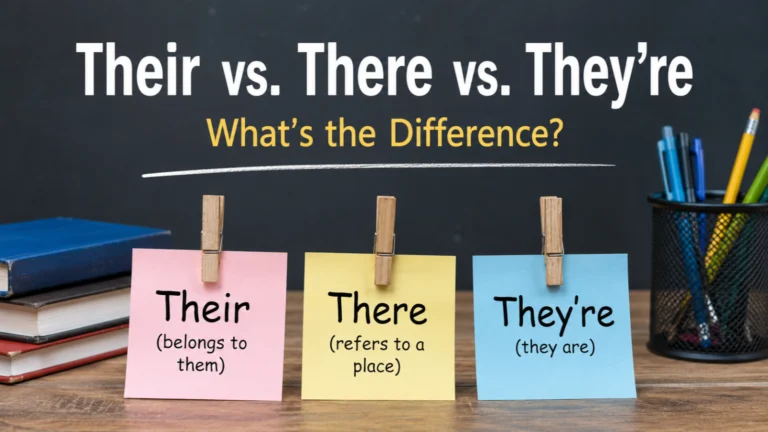
Their vs There vs They’re is one of the most common grammar topics that confuses English learners because these three words sound exactly alike but have completely different meanings. Using the wrong word can make even well-written sentences look incorrect and affect your confidence in writing.
Understanding the difference is simple once you know when each word should be used. Their vs There vs They’re is an essential lesson for students, professionals, writers, and anyone who wants to improve their English grammar and avoid common mistakes. In this guide, you’ll learn clear definitions, easy examples, practical tips, and memory tricks that make choosing the correct word effortless.
By the end, Their vs There vs They’re will no longer be confusing.
Table of Contents
- Introduction
- Why “Their,” “There,” and “They’re” Are Confusing
- Their vs There vs They’re Explained Simply
- Understanding Homophones in English
- What Does “Their” Mean?
- What Does “There” Mean?
- What Does “They’re” Mean?
- Their vs There vs They’re: Key Differences at a Glance
- How to Remember the Difference
- Common Mistakes and Confusions
- Examples Section: Correct and Incorrect Usage
- Self Assessment: Test Your Knowledge
- Self Assessment Answers
- FAQs About “Their,” “There,” and “They’re”
- Final Conclusion
Why “Their,” “There,” and “They’re” Are Confusing
Many people—even native English speakers—mix up these three words. Here are the main reasons why.
Similar Pronunciation
All three words are pronounced the same way. Since they sound identical, it is easy to choose the wrong spelling while writing.
Similar Spelling
Each word begins with “the-“, making them look very similar at first glance.
Context Confusion
Writers often focus on the sound instead of the meaning. Because of this, they accidentally use the wrong word.
Common Learner Mistakes
Some frequent mistakes include:
- Writing there instead of their.
- Using their when talking about a place.
- Forgetting that they’re is a contraction.
- Choosing words based on pronunciation rather than grammar.
Their vs There vs They’re Explained Simply
Their means something belongs to people.
There refers to a place or introduces a sentence.
They’re is the shortened form of they are.
One-Line Distinction
Their shows ownership, there shows location or introduces a sentence, while they’re means they are.
Examples
- Their house is very beautiful.
- I borrowed their books.
- The restaurant is over there.
- There is a new teacher at school.
- They’re going to the park.
- I think they’re ready.
Understanding Homophones in English
What Are Homophones?
Homophones are words that have the same pronunciation but different meanings and spellings.
Example:
- Sea
- See
These words sound alike but have different meanings.
Why Homophones Cause Confusion
Since homophones sound identical, people often write the wrong word.
Example:
- Their dog is friendly. ✔
- There dog is friendly. ✘
The sentence sounds correct when spoken, but only one spelling is grammatically correct.
What Does “Their” Mean?
Definition and Core Meaning
Their is a possessive adjective. It shows that something belongs to two or more people or sometimes to a person whose gender is unknown.
Origin and Historical Use
The word their comes from Old Norse and has been used in English for hundreds of years to express possession.
Modern Usage and Synonyms
It commonly replaces phrases like:
- Belonging to them
- Owned by them
- Associated with them
Key Points
- Shows ownership.
- Comes before a noun.
- Used for people, groups, and organizations.
Example Sentences
- Their teacher is very helpful.
- The children packed their bags.
- Their company is expanding quickly.
- Everyone should bring their notebook.
What Does “There” Mean?
Definition and Core Meaning
There usually refers to a place or location. It can also introduce a sentence.
Origin and Historical Context
The word has existed since Old English and has long been used to indicate position or existence.
Modern Usage and Synonyms
Depending on context, it may mean:
- In that place
- At that location
- Existing
Key Points
- Refers to a place.
- Introduces sentences such as “There is…”
- Does not show ownership.
Example Sentences
- Please sit over there.
- There is a mistake in this report.
- We stopped there for lunch.
- Is there enough time?
What Does “They’re” Mean?
Definition and Core Meaning
They’re is a contraction of they are.
Origin and Historical Context
English contractions became common to make speaking and writing more natural. They’re combines they and are.
Modern Usage and Synonyms
Equivalent to:
- They are
Key Points
- Always means they are.
- Never shows ownership.
- Common in everyday conversation and informal writing.
Example Sentences
- They’re studying English.
- They’re excited about the trip.
- I know they’re coming.
- They’re the winners.
Their vs There vs They’re: Key Differences at a Glance
| Word | Part of Speech | Meaning | Example Context |
|---|---|---|---|
| Their | Possessive adjective | Shows ownership | Their car is new. |
| There | Adverb, pronoun, noun | Refers to a place or introduces a sentence | There is a problem. |
| They’re | Contraction | Means “they are” | They’re happy today. |
How to Remember the Difference
Remembering these words becomes easier with a few simple tricks.
Easy Memory Tricks
- Their contains the word heir, and an heir inherits property. Think of ownership.
- There contains here. Both relate to places.
- They’re has an apostrophe because two words have been combined.
Association Techniques
Ask yourself these questions:
- Is something owned by people? → Their
- Is it talking about a place or existence? → There
- Can I replace it with they are? → They’re
Memorable Example
They’re taking their dog over there.
This sentence uses all three words correctly.
Common Mistakes and Confusions
Wrong
Their is my school.
Correct
There is my school.
Explanation: The sentence refers to a location.
Wrong
There books are on the table.
Correct
Their books are on the table.
Explanation: The books belong to someone.
Wrong
Their going shopping.
Correct
They’re going shopping.
Explanation: “They’re” means “they are.”
Wrong
They’re classroom is clean.
Correct
Their classroom is clean.
Explanation: Ownership requires their.
Examples Section: Correct and Incorrect Usage
Example 1
✔ Correct: Their parents are waiting outside.
✘ Incorrect: There parents are waiting outside.
Example 2
✔ Correct: There is a beautiful garden nearby.
✘ Incorrect: Their is a beautiful garden nearby.
Example 3
✔ Correct: They’re watching a movie.
✘ Incorrect: Their watching a movie.
Example 4
✔ Correct: We left our bags over there.
✘ Incorrect: We left our bags over their.
Example 5
✔ Correct: They’re proud of their achievements.
✘ Incorrect: There proud of their achievements.
Example 6
✔ Correct: There are many students in the classroom.
✘ Incorrect: They’re many students in the classroom.
Self Assessment: Test Your Knowledge
Fill in the blanks with their, there, or they’re.
- ______ going to visit us tomorrow.
- We parked our car over ______.
- The students forgot ______ homework.
- ______ are many interesting books in the library.
Self Assessment Answers
- They’re
- There
- Their
- There
FAQs About “Their,” “There,” and “They’re”
1. What is the difference between their, there, and they’re?
Their shows ownership, there refers to a place or existence, and they’re means they are.
2. Is “they’re” always short for “they are”?
Yes. If you cannot replace it with they are, then they’re is incorrect.
3. How can I remember when to use “their”?
Think of their as showing ownership or belonging.
4. Is “there” only used for places?
No. It also introduces sentences like “There is” and “There are.”
5. Why do people confuse these words?
Because they sound exactly the same even though they have different spellings and meanings.
6. Are these words homophones?
Yes. They are perfect examples of English homophones.
7. Do native English speakers make these mistakes?
Yes. These are among the most common writing mistakes in English, even for native speakers.
Final Conclusion
Understanding the difference between their, there, and they’re is an important step toward becoming a more confident English writer. Although these words sound exactly the same, each one has a unique purpose. Their shows ownership, there refers to a place or introduces a sentence, and they’re is simply the contraction of they are. Once you recognize these roles, choosing the correct word becomes much easier.
A simple way to avoid mistakes is to pause before writing. Ask yourself whether you are talking about something that belongs to someone, describing a location, or saying “they are.” This quick check can prevent many common grammar errors. Reading your sentence aloud and replacing they’re with they are is another useful trick. If the sentence still makes sense, you’ve chosen the correct word.
Practice is the key to mastering these commonly confused words. Read English books, write short paragraphs, and complete grammar exercises regularly. The more examples you see, the more natural the correct usage will become. Over time, you will recognize the right word instantly without needing to stop and think. Every small improvement strengthens your writing skills, so keep practicing, stay curious, and remember that even experienced writers occasionally review grammar. With consistent effort, you’ll use their, there, and they’re correctly in every conversation, email, assignment, and professional document.