Many English learners struggle with affect and effect because the two words look and sound similar. They often appear in the same types of conversations, especially when discussing change, results, or consequences.
Even native English speakers sometimes confuse them in writing. Fortunately, the difference is much simpler than it first appears.
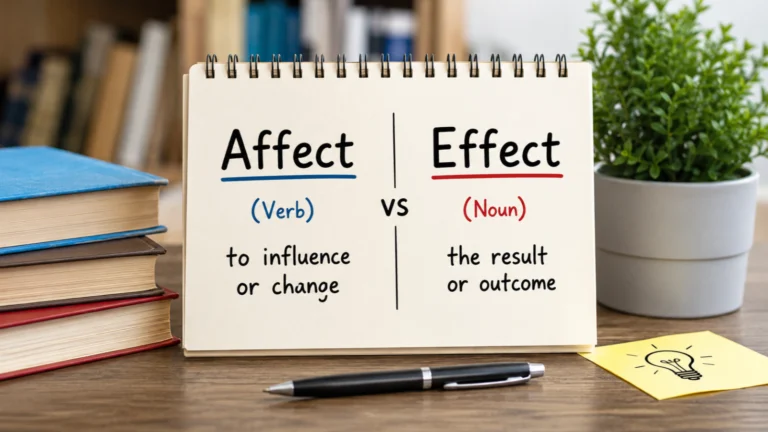
In most situations, affect is a verb that means “to influence,” while effect is a noun that means “the result of a change.” Once you understand this basic rule and practice with real examples, choosing the correct word becomes much easier.
This guide explains everything you need to know in clear, simple English.
Why “Affect” and “Effect” Are Confusing
There are several reasons why English learners often mix up affect and effect.
Similar Pronunciation
The two words are pronounced very similarly, especially in fast speech. This makes it difficult to tell them apart when listening.
Similar Spelling
Only one letter is different, so learners may accidentally type or write the wrong word.
Context Confusion
Both words usually appear when talking about change, influence, or results. Since they are closely related in meaning, people often use one when they actually need the other.
Common Learner Mistakes
Some of the most common mistakes include:
- Using effect as a verb when affect is needed.
- Using affect as a noun when effect is correct.
- Assuming both words are interchangeable.
- Forgetting that one usually describes an action while the other describes a result.
Affect vs Effect Explained Simply
The easiest way to remember the difference is this:
Affect means to influence something, while effect means the result of that influence.
One-Line Distinction
Affect = influence (verb)
Effect = result (noun)
Example Sentences
- Loud music can affect your concentration.
- The new medicine had a positive effect on her health.
Another example:
- Lack of sleep can affect your memory.
- Better sleep has a good effect on learning.
Understanding Homophones in English
What Are Homophones?
Homophones are words that sound the same or very similar but have different meanings and often different spellings.
Example:
- Their
- There
Although affect and effect are not perfect homophones in every accent, they are similar enough in pronunciation that many learners confuse them.
Why Homophones Cause Confusion
When words sound alike, people may rely on pronunciation instead of meaning.
For example:
“I don’t know whether to write affect or effect.”
Understanding each word’s purpose is much more important than memorizing spelling alone.
What Does “Affect” Mean?
Definition and Core Meaning
Affect is most commonly used as a verb.
It means:
- To influence someone or something.
- To produce a change.
- To have an impact on.
Origin and Historical Use
The word affect comes from the Latin word afficere, meaning “to influence” or “to act upon.” It entered English through French during the Middle Ages and has been used for centuries to describe influence or emotional impact.
Modern Usage and Synonyms
Today, affect is commonly used in everyday English, education, business, science, and medicine.
Synonyms include:
- Influence
- Change
- Impact
- Alter
- Modify
- Shape
Examples
- Weather can affect travel plans.
- Stress can affect your health.
- Good teachers affect students’ lives positively.
- Rising prices affect everyone.
What Does “Effect” Mean?
Definition and Core Meaning
Effect is usually a noun.
It means:
- The result of a change.
- An outcome.
- A consequence.
Origin and Historical Context
The word effect comes from the Latin word effectus, meaning “accomplishment” or “result.” It has been used in English for hundreds of years to describe outcomes and consequences.
Modern Usage and Synonyms
Today, effect appears in academic writing, business, science, healthcare, and everyday conversations.
Synonyms include:
- Result
- Outcome
- Consequence
- Impact
- Product
- Aftermath
Examples
- Exercise has a positive effect on mental health.
- The new law had little effect on crime.
- The special effects in the movie looked realistic.
- The medicine produced the desired effect.
Affect vs Effect: Key Differences at a Glance
| Word | Part of Speech | Meaning | Example Context |
|---|---|---|---|
| Affect | Verb | To influence or change something | The weather affects our plans. |
| Effect | Noun | The result or outcome of a change | The rain had a negative effect on the game. |
How to Remember the Difference Between Affect and Effect
Fortunately, there are several simple memory tricks.
Easy Memory Tricks
- A = Action = Affect
- E = End Result = Effect
Think of it like this:
First, something affects a situation.
Then you see the effect.
Association Techniques
Imagine a row of dominoes.
The first domino falling affects the others.
The last fallen domino is the effect.
One Memorable Example
“The storm affected the crops.”
“The effect was a poor harvest.”
The first sentence describes the action.
The second sentence describes the result.
Common Mistakes and Confusions
Wrong Example
❌ The weather had a bad affect on the trip.
✅ The weather had a bad effect on the trip.
Explanation: You need the noun meaning “result.”
Wrong Example
❌ Pollution effects wildlife.
✅ Pollution affects wildlife.
Explanation: Here you need the verb meaning “influences.”
Wrong Example
❌ His speech had no affect.
✅ His speech had no effect.
Explanation: The sentence talks about the result.
Wrong Example
❌ Lack of water effected plant growth. (In everyday English.)
✅ Lack of water affected plant growth.
Explanation: Most of the time, affect is the correct verb. (Note: effect can occasionally be used as a verb meaning “to bring about,” but this is much less common.)
Examples Section: Correct and Incorrect Usage
Example 1
✔ Correct: Exercise can affect your mood.
✘ Incorrect: Exercise can effect your mood.
Example 2
✔ Correct: The medicine had an immediate effect.
✘ Incorrect: The medicine had an immediate affect.
Example 3
✔ Correct: Climate change affects ecosystems worldwide.
✘ Incorrect: Climate change effects ecosystems worldwide.
Example 4
✔ Correct: The policy had a positive effect on employment.
✘ Incorrect: The policy had a positive affect on employment.
Example 5
✔ Correct: Poor communication can affect teamwork.
✘ Incorrect: Poor communication can effect teamwork.
Example 6
✔ Correct: The new training program produced a noticeable effect.
✘ Incorrect: The new training program produced a noticeable affect.
Self Assessment: Test Your Knowledge
Fill in the blanks with affect or effect.
1.
Too much screen time can ______ your sleep.
2.
The new rules had a positive ______ on safety.
3.
High temperatures ______ food quality.
4.
The medicine produced the desired ______.
Self Assessment Answers
- affect
- effect
- affect
- effect
FAQs About “Affect” and “Effect”
1. Is affect a verb or a noun?
Most of the time, affect is a verb that means “to influence.”
2. Is effect a noun or a verb?
Usually, effect is a noun meaning “a result.” It can also be a verb meaning “to bring about,” but this use is much less common.
3. Can affect and effect ever both be verbs?
Yes. While affect is commonly used as a verb, effect can also be a verb in formal English, meaning “to cause” or “to bring about.” However, this usage is rare.
4. Which is more common in everyday English?
The most common pattern is:
- affect = verb
- effect = noun
This rule works correctly in most everyday situations.
5. How can I remember the difference easily?
Remember:
- Affect = Action
- Effect = End Result
This simple trick helps in most writing situations.
6. Why do native speakers confuse these words?
Because they look alike, sound similar, and are closely connected in meaning. Even experienced writers sometimes make mistakes without careful proofreading.
7. Are affect and effect interchangeable?
No. In most sentences, they have different grammatical roles and cannot be swapped without changing the meaning or creating an error.
Final Conclusion: Using “Affect” and “Effect” Correctly
Understanding the difference between affect and effect is one of the most useful grammar skills for English learners. Although these words look and sound similar, remembering their main roles makes them much easier to use. In everyday English, affect is usually a verb that means “to influence” or “to change something,” while effect is typically a noun that refers to the result or consequence of that influence. Keeping this simple rule in mind will help you avoid one of the most common mistakes in English writing.
As you continue learning, pay attention to how these words appear in books, articles, news reports, and conversations. Reading authentic English and practicing with your own sentences will gradually make the difference feel natural. You can also use the memory trick “Affect = Action” and “Effect = End Result” whenever you are unsure which word to choose. Over time, this quick reminder will become second nature.
Don’t worry if you make mistakes at first—even fluent speakers occasionally confuse these words. The key is to practice regularly, review real examples, and focus on the meaning rather than the spelling alone. With consistent practice, you’ll soon use affect and effect confidently and correctly in both speaking and writing, making your English clearer, more accurate, and more professional.