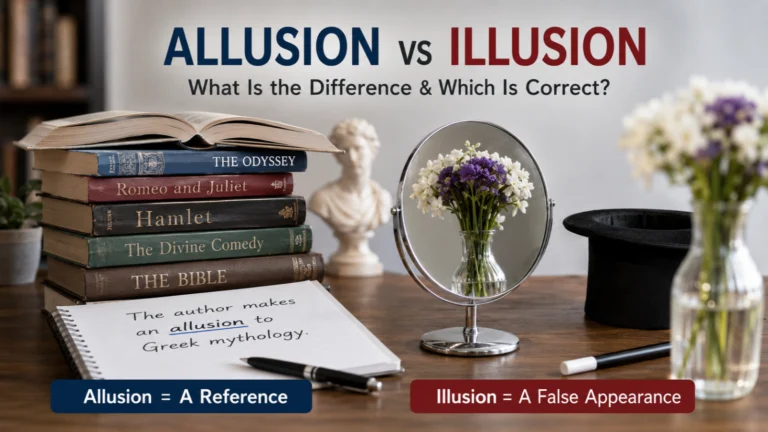
Allusion vs Illusion is a common point of confusion for English learners because the two words look and sound similar but have completely different meanings. Understanding the difference is essential for improving vocabulary, writing, reading comprehension, and everyday communication. An allusion is an indirect reference to a person, event, book, or idea, while an illusion is something that deceives the senses or creates a false impression of reality. Mixing them up can change the meaning of a sentence and lead to misunderstandings. In this guide, you’ll learn Allusion vs Illusion through simple definitions, practical examples, key differences, and easy memory tips. By the end, you’ll know exactly when to use each word with confidence.
Why “Allusion” and “Illusion” Are Confusing
Many English learners accidentally confuse allusion and illusion for several reasons.
Similar Pronunciation
Both words begin with “all-” or “ill-” and end with “-usion.” When spoken quickly, they sound quite alike, especially to non-native English speakers.
Similar Spelling
The only noticeable spelling difference is the first few letters:
- Allusion
- Illusion
Because the endings are identical, many learners mistakenly swap them.
Context Confusion
Both words often appear in books, speeches, literature, and formal writing. Without knowing their meanings, readers may assume they are interchangeable.
Common Learner Mistakes
People often write:
- “The magician created an allusion.”
- “The author made an illusion to Shakespeare.”
Both examples are incorrect because the meanings have been mixed up.
Allusion vs Illusion Explained Simply
Allusion means an indirect reference to someone, something, or another piece of writing, while illusion means something that deceives your senses or appears different from reality.
One-Line Distinction
Allusion refers to a reference; illusion refers to a false appearance.
Example Sentences
Allusion
- The writer made an allusion to Greek mythology.
- Her speech included an allusion to a famous historical event.
Illusion
- The mirror created an illusion of a larger room.
- The magician amazed the audience with a clever illusion.
Understanding Homophones in English
What Are Homophones?
Homophones are words that sound the same or very similar but have different meanings and often different spellings.
Example:
- Sea
- See
Although they sound identical, they have completely different meanings.
Why Homophones Cause Confusion
Homophones confuse learners because people usually hear words before they learn to spell them.
For example:
- Their
- There
- They’re
These words sound alike but are used in different situations. Likewise, allusion and illusion sound similar, making them easy to confuse.
What Does “Allusion” Mean?
Definition and Core Meaning
An allusion is an indirect or passing reference to a person, event, book, movie, historical figure, or cultural idea. The speaker or writer expects the audience to recognize the reference without explaining it directly.
Unlike a detailed explanation, an allusion simply hints at something.
Origin and Historical Use
The word allusion comes from the Latin word alludere, meaning “to play with” or “to refer indirectly.”
It entered English during the 16th century and became especially common in literature and public speaking.
Modern Usage and Synonyms
Today, allusion is frequently used in:
- Literature
- Essays
- Speeches
- Journalism
- Academic writing
Synonyms
- Reference
- Mention
- Hint
- Suggestion
- Indirect citation
Example Sentences
- The novel contains an allusion to the Bible.
- His joke was an allusion to a famous movie.
- The politician made an allusion to past economic problems.
- Shakespeare’s works contain many classical allusions.
What Does “Illusion” Mean?
Definition and Core Meaning
An illusion is a false idea, misleading appearance, or trick that makes something seem different from what it actually is.
Illusions can fool your eyes, mind, or emotions.
Origin and Historical Context
The word illusion comes from the Latin illusio, meaning “mockery” or “deception.”
It has been used in English since the 14th century to describe visual tricks, mistaken beliefs, and deceptive appearances.
Modern Usage and Synonyms
Today, illusion commonly appears in discussions about:
- Magic
- Psychology
- Art
- Photography
- Science
- Optical illusions
Synonyms
- Deception
- Mirage
- False impression
- Trick
- Delusion (in some contexts)
Example Sentences
- The artist created an amazing optical illusion.
- Happiness can sometimes be an illusion if it is based on lies.
- The magician performed a fascinating illusion.
- The road looked wet, but it was only an illusion.
Allusion vs Illusion: Key Differences at a Glance
| Word | Part of Speech | Meaning | Example Context |
|---|---|---|---|
| Allusion | Noun | An indirect reference | The author made an allusion to Romeo and Juliet. |
| Illusion | Noun | A false appearance or deception | The mirror created the illusion of extra space. |
How to Remember the Difference Between Allusion and Illusion
Fortunately, there are several easy ways to remember these words.
Easy Memory Tricks
Allusion = Alludes
Notice that allusion comes from allude, which means to refer indirectly.
Think:
Allusion → Allude → Reference
Illusion = Ill
An illusion tricks your brain and makes reality seem “ill” or incorrect.
Think:
Illusion → Illusionist → Magic Trick
Association Techniques
- Allusion is connected with books, speeches, history, and references.
- Illusion is connected with magic, mirrors, dreams, and visual tricks.
One Memorable Example
“The author made an allusion to Harry Potter, while the magician created an illusion with disappearing cards.”
Common Mistakes and Confusions
Wrong Example
❌ The magician performed an allusion.
✅ The magician performed an illusion.
Explanation: A magician creates visual tricks, not references.
Wrong Example
❌ The writer included an illusion to Shakespeare.
✅ The writer included an allusion to Shakespeare.
Explanation: Writers refer to famous works through allusions.
Wrong Example
❌ The mirror made an allusion.
✅ The mirror created an illusion.
Explanation: Mirrors create deceptive appearances.
Wrong Example
❌ His speech contained several illusions to history.
✅ His speech contained several allusions to history.
Explanation: Historical references are allusions.
Examples Section: Correct and Incorrect Usage
Example 1
✔ Correct: The speech included an allusion to Abraham Lincoln.
✘ Incorrect: The speech included an illusion to Abraham Lincoln.
Example 2
✔ Correct: The magician amazed everyone with a clever illusion.
✘ Incorrect: The magician amazed everyone with a clever allusion.
Example 3
✔ Correct: The poem contains an allusion to Greek mythology.
✘ Incorrect: The poem contains an illusion to Greek mythology.
Example 4
✔ Correct: The painting creates the illusion of movement.
✘ Incorrect: The painting creates the allusion of movement.
Self Assessment: Test Your Knowledge
Fill in the blanks with allusion or illusion.
- The author made an __________ to a famous fairy tale.
- The mirror created the __________ of a larger room.
- The politician’s speech contained an __________ to history.
- The magician performed an amazing __________.
Self Assessment Answers
- Allusion
- Illusion
- Allusion
- Illusion
FAQs About “Allusion and Illusion”
1. What is the main difference between allusion and illusion?
An allusion is an indirect reference to something, while an illusion is something that appears real but is actually deceptive or misleading.
2. Are allusion and illusion interchangeable?
No. Although they sound similar, they have different meanings and should never be used interchangeably.
3. Which word is used in literature?
Allusion is commonly used in literature because authors often refer indirectly to famous people, events, myths, or books.
4. Which word is related to magic?
Illusion is associated with magic, visual tricks, and deceptive appearances.
5. Is an optical illusion the same as an allusion?
No. An optical illusion tricks your eyes, while an allusion is a reference in speech or writing.
6. How can I remember the difference easily?
Remember this simple rule:
- Allusion = Allude = Reference
- Illusion = Illusionist = Magic Trick
7. Why do English learners confuse these words?
They have similar pronunciation, nearly identical spelling, and both often appear in formal English, making them easy to mix up.
Final Conclusion: Using “Allusion” and “Illusion” Correctly
Understanding the difference between allusion and illusion is an important step toward improving your English vocabulary and writing skills. Although these words look and sound alike, they describe two very different ideas. An allusion is an indirect reference to a person, event, book, or cultural idea, often used to enrich writing by connecting it with something familiar. An illusion, on the other hand, is a false appearance or deceptive impression that tricks the eyes or mind. Keeping this distinction in mind will help you avoid one of the most common vocabulary mistakes made by English learners.
A simple memory trick can make the difference stick: allusion comes from allude, which means “to refer,” while illusion is closely linked to illusionists and the world of magic, where appearances can be misleading. Whenever you encounter one of these words, think about the context. Is someone making a reference, or is something creating a false impression? Asking yourself that question will usually lead you to the correct choice.
As you continue learning English, don’t be discouraged by pairs of confusing words. Many learners face the same challenge, and every new distinction you master strengthens your communication skills. Keep practicing with real examples, pay attention to context, and revisit these memory tips whenever needed. With consistent practice, using allusion and illusion correctly will soon become second nature, helping you write and speak with greater confidence and precision.