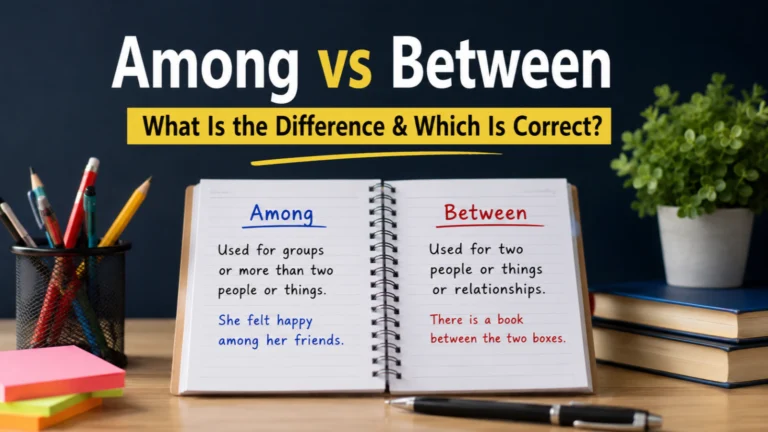
Among vs Between is one of the most common grammar topics that confuses English learners. Many people assume these two prepositions can be used interchangeably, but they have different meanings and are used in different situations.
Understanding the distinction helps you write and speak English more accurately, whether you’re communicating in everyday conversations, academic writing, or professional settings. In this guide, you’ll learn the simple rules, practical examples, and common mistakes that make these words easier to remember.
By the end, Among vs Between will no longer be confusing, and you’ll know exactly which word to choose with confidence in any sentence.
Why “Among” and “Between” Are Confusing
The words among and between confuse many English learners because they both describe relationships involving more than one person or object.
Similar Pronunciation
Both words are short, common prepositions and are frequently used in everyday English. Since they often appear in similar sentences, learners sometimes choose the wrong one.
Similar Spelling
Although their spellings are different, both begin with similar sounds and are often taught together in English grammar lessons.
Context Confusion
Many people learn the simple rule:
- Between = two things
- Among = three or more things
While this rule works in many situations, it is not always correct. Between can also be used with more than two people or things when individual relationships are involved.
Common Learner Mistakes
Learners often say:
- Their parents divided the money between the five children.
- “There is an agreement among the two companies.”
These sentences may not always be correct because the choice depends on the relationship, not only the number.
Among vs Between Explained Simply
Among means being part of a group or surrounded by several people or things, while between refers to a relationship, connection, or separation involving distinct people or things.
One-Line Distinction
Use “among” for groups; use “between” for individual relationships or clear separations.
Examples
Among
- She found her keys among the books.
- The teacher walked among the students.
Between
- The ball rolled between the chairs.
- There is strong trust between the two friends.
Understanding Homophones in English
What Are Homophones?
Homophones are words that sound the same but have different meanings and often different spellings.
Example:
- Sea
- See
They sound identical but mean different things.
Why Homophones Cause Confusion
Homophones can confuse learners because pronunciation does not always reveal the correct spelling or meaning.
Example:
- I can see the ocean.
- The sea is calm today.
Although among and between are not homophones, they are commonly confused because they have related meanings and appear in similar situations.
What Does “Among” Mean?
Definition and Core Meaning
Among is a preposition that means in the middle of a group, surrounded by, or included within several people or things.
It focuses on being part of a collection rather than on individual relationships.
Origin and Historical Use
The word among comes from Old English gemang, meaning “in company with” or “mixed with.” It has been used for centuries to describe being surrounded by people, objects, or ideas.
Modern Usage and Synonyms
Today, among commonly appears in both spoken and written English.
Synonyms
- Amid
- Amidst
- In the middle of
- Surrounded by
- Included with
Example Sentences
- She was sitting among her friends.
- We found a rare flower among the trees.
- The news spread quickly among the villagers.
- He felt comfortable among experienced professionals.
What Does “Between” Mean?
Definition and Core Meaning
Between is a preposition that describes a relationship, separation, or connection involving distinct people, places, or things.
It often refers to two items, but it can also refer to more than two when each relationship is considered individually.
Origin and Historical Context
The word between comes from Old English betweonum, meaning “in the space separating.” It has always emphasized separation or connection.
Modern Usage and Synonyms
Today, between is widely used to describe distance, comparison, agreement, sharing, and communication.
Synonyms
- Connecting
- Separating
- In the space separating
- Linking
- Dividing
Example Sentences
- The bridge connects the land between the rivers.
- The agreement was signed between the three companies.
- Choose between tea and coffee.
- There is healthy competition between the teams.
Among vs Between: Key Differences at a Glance
| Word | Part of Speech | Meaning | Example Context |
|---|---|---|---|
| Among | Preposition | Part of or surrounded by a group | She walked among the crowd. |
| Between | Preposition | Relationship or separation involving distinct people or things | The discussion was between the manager and employees. |
How to Remember the Difference Between Among and Between
Remembering these words becomes easier with simple memory tricks.
Easy Memory Tricks
- Among = A Group
- Think of among as being inside a crowd.
- Between = A Connection
- Think of a line connecting separate people or objects.
Association Techniques
Imagine yourself standing among hundreds of trees in a forest.
Now imagine a rope stretched between two trees.
One shows being inside a group.
The other shows a direct relationship.
Memorable Example
- She stood among the audience.
- She stood between her parents.
Common Mistakes and Confusions
Wrong
❌ The prize was shared among the two winners.
Correct
✔ The prize was shared between the two winners.
Explanation: Two distinct people are involved.
Wrong
❌ She felt lonely between strangers.
Correct
✔ She felt lonely among strangers.
Explanation: Strangers form a group.
Wrong
❌ The secret spread between the villagers.
Correct
✔ The secret spread among the villagers.
Explanation: It spread throughout a group.
Wrong
❌ There was an agreement among the two friends.
Correct
✔ There was an agreement between the two friends.
Explanation: The agreement connects two individuals.
Examples Section: Correct and Incorrect Usage
Example 1
✔ Correct: She hid among the bushes.
✘ Incorrect: She hid between the bushes.
Example 2
✔ Correct: The negotiations continued between the three countries.
✘ Incorrect: The negotiations continued among the three countries.
Example 3
✔ Correct: Happiness spread among the children.
✘ Incorrect: Happiness spread between the children.
Example 4
✔ Correct: Divide the money between the five partners.
✘ Incorrect: Divide the money among the five partners.
Why? The money is divided into individual shares for each partner, making between acceptable.
Self Assessment: Test Your Knowledge
Fill in the blanks with among or between.
- She was standing ________ the crowd.
- The discussion took place ________ the two managers.
- The secret spread quickly ________ the students.
- The agreement was signed ________ the five countries.
Self Assessment Answers
- among
- between
- among
- between
FAQs About “Among and Between”
1. What is the main difference between among and between?
Among refers to being part of a group, while between refers to relationships or separations involving distinct people or things.
2. Can “between” be used for more than two people?
Yes. Modern English allows between for more than two people when individual relationships are emphasized.
Example: The treaty was signed between six nations.
3. When should I use “among”?
Use among when referring to a group without focusing on individual connections.
4. Is “between” always used for only two things?
No. Although it often refers to two, it can also describe relationships involving several distinct individuals or groups.
5. Is “amongst” the same as “among”?
Yes. Amongst has the same meaning but sounds more formal or literary, especially in British English.
6. Which word is more common in everyday English?
Both are common, but among is more frequent when talking about groups, while between is common when discussing choices, agreements, comparisons, or distances.
7. How can I remember the difference easily?
Think of among as being inside a group, and between as describing a connection or separation between distinct people or things.
Final Conclusion: Using “Among” and “Between” Correctly
Understanding the difference between among and between is an important step toward speaking and writing English with greater confidence. Although these two prepositions are closely related, they are not interchangeable in every situation. Among is generally used when referring to a group or when someone or something is surrounded by several people or objects. Between, on the other hand, highlights a relationship, comparison, agreement, division, or separation involving distinct people, places, or things—even when there are more than two of them.
A helpful way to remember the distinction is to picture yourself standing among a crowd but talking between two friends. If you are thinking about a collection as a whole, among is usually the right choice. If you are focusing on individual connections or clearly defined participants, between is often the better option.
Like many English grammar rules, real-life usage sometimes goes beyond the simplest explanations. Reading books, listening to native speakers, and practicing with your own sentences will help you recognize the correct choice naturally over time. Don’t worry if you make mistakes at first—every learner does. With regular practice and the memory tips in this guide, you’ll soon be able to use among and between correctly in conversations, writing, exams, and everyday communication with confidence.